Smiling Gods

A red and a white are the usual sacrifices to the Gods of the weekend, and this time the Dieties of rest and relaxation were smiling down on me with both wines a notch above the usual tipples.

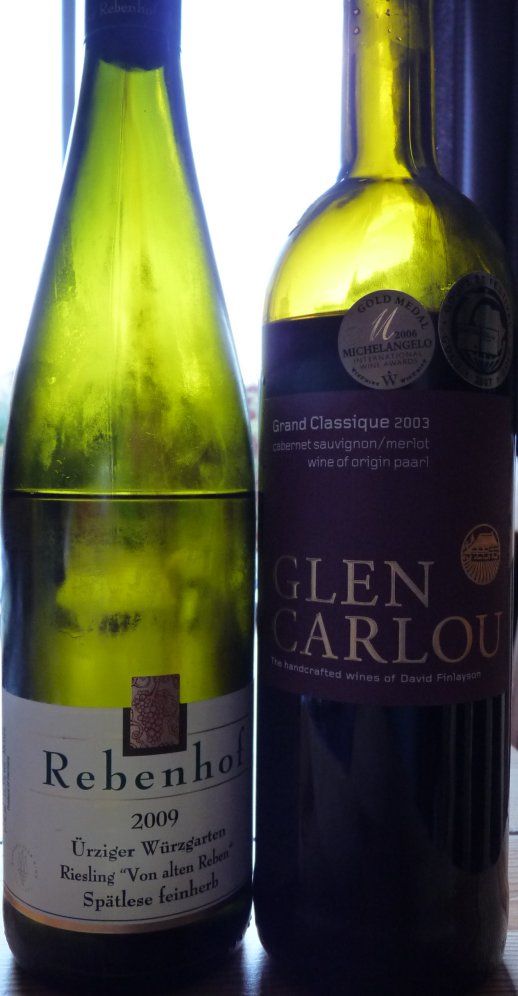
White is Riesling (an oft heard cry in the household!) and this one has barely had time to settle after its journey back from Germany two weeks ago, one of the stash of wines I purchased on my Mosel visit in June. The Rebenhof 2009  Ürziger Würzgarten Spätlese feinherb Von alten Reben was purchased from the cellar door for €13.25 and was opened so soon (for me) as I’d noticed a little leakage from the Stelvin cap after getting it home – so better to drink it quickly than risk oxidation (that’s the only gripe I have against Stelvin closures, they don’t handle travel & rough baggage handlers as well as cork).

The old vine off-dry Riesling (Feinherb is the in-vogue rebranding for the out of fashion Halbtrocken category) comes in at 11.5% abv and has a clean, buttery nose which mellows into lemon & lime sherbert with just a hint of waxy petrochem’. The texture arrives first, quite full with gentle sweetness and a spritz at the beginning, then dryness on the mid-palate as the acid minerality raises its head, finishing with a touch of grapefruit. Not overly complex but a well made with restrained sugar for the style,  3+ stars (88-89pts).
Winemaker Johannes Schmitz uses 80+ year old vines for his Alten Reben, and if it wasn’t for the leakage I’d have probably put this one away for a good 5+ years to let it develop some extra character, but its drinking very nicely now in its youthful phase.

As for the red, this is one of the older bottles in my collection, having been purchased on a business trip to South Africa in August 2007 for the princely sum of £8.33 (from Bootleggers Bottle Shop, Fourways Crossing, Johannesburg).

The Glen Carlou 2003 Grand Classique is an old-school Bordeaux blend of 50 % Cabernet Sauvignon, 35 % Merlot, 5 % Cabernet Franc, 8 % Malbec and 2 % Petit Verdot, barrel-aged for finesse and longevity.As soon as I pulled the cork I knew I was in for a good time, a sweet, smoky spice aroma jumped out of the bottle. Although this is a dark wine the age can be seen from the rusty edges on the swirl, which also releases chocolate, cool mint, vanilla and a touch of farmyard aromas. In the mouth this is perfectly balanced with a touch of acidity and a little savoury aspect and a big dollop of chocolate with a warming finish – this is a pleasure to drink, a superb wine hardly showing its 14.5% abv and a clear 4 stars (91-92pts).

Slainte!

Posted in Just having a drink | Tagged , , , | Comments Off on Smiling Gods

Tonight’s Tipple – 2009 Beaujolais

Beaujolais 2009 has been lauded as a great vintage for the region, exceptional even. I’m not a great Beaujolais drinker, typically getting through only 1 or 2 a year, but when a vintage is pronounced exceptional then I will always buy a bottle or two to try.

Cave du Château de Chénas 2009 Fleurie came from my local Co-op store in Prudhoe in February this year for a very reasonable £6.99. At 13% abv it is lighter than many a red wine available today, but is the better for it as I’ve had a couple of glasses already and still feel that I can competently type without spell-checking every second word!

Tasting Notes.
A vibrant young colour, deep red/magenta. This has fresh and fruity aromas in the glass, light red berries. It is gentle in the mouth, sweet fruit (heading towards blueberry bubblegum), light tannins and balanced acidity.
Lightly chilled this is a very easy drinking wine, not too complex, but well made and great value. 87-88pts (3 star).

I have two more ’09 Beaujolais left for future drinking, a Louis Latour Brouilly and a Côte du Py Morgon. Both were a little more expensive than the Fleurie so, based on tonight’s experience, I’m looking forward to opening them.

Slainte!

Posted in Just having a drink | Tagged , | Comments Off on Tonight’s Tipple – 2009 Beaujolais

PortoVino Summer Tasting at the Biscuit Factory

Portuguese wine retailer PortoVino, run by Alan Holmes and Paul Raven (fellow NEWTS), held their summer tasting at the Biscuit Factory in Newcastle last Thursday evening (can there be a better venue for a tasting than an art gallery?). I first wrote about them back in August 2009 on Reign of Terroir only a few months after they set up shop and have sampled their wares, on and off, for the last 2 years at various local tastings events.

First up was the Quinta da Romiera 2006 Bruto from Bucelas near Lisbon, a traditional method sparkler made from the Arinto grape. The Quinta is one of the Companhia das Quintas, a group of several wineries marketed together, and had produced a grown up glass of fizz with a dry, unripe apple aspect, some stone-fruit bitterness and a warming finish – very palatable and, at £15 a bottle, the match of many more expensive Champagnes.

Then onto a Quinta Cazas Novas 2010 Vinho Verde Bianco; Arinto and Avesso grapes giving a fresh, fruity nose with strong aromatics, although it was lighter on the taste than suggested. Clean and dry this had a herbal bitterness, going rich on the finish – well made and reasonably priced at £9.50 a bottle this was popular in the room but didn’t excite me.

The Quinta do Cardo 2009 Síria (that’s the grape) was poured next from one of the highest altitude wineries in Portugal, based in the Beira Interior DOC. The Síria had a rich, floral nose and a textured mouthfeel; creamy, balanced with a little alcohol spice – a serious wine and one I thoroughly enjoyed, probably worth the £10.75 being asked.

The 2008 Morgado de Sta. Catherina by Quinta da Romeira moved us back to the Arinto grape, but this time with some oak thrown in for good measure. Barrel fermented on its lees this is a big wine, compared by some to a good white Burgundy, and I’ve tasted earlier vintages previously. You could smell the wood components rising up from the glass and I enjoyed a citrus bite on the tip of the tongue before it moved into a smooth and complex phase all the way to the finish – good throughout and very well made, however, for £16.75 a bottle I wanted a little more variation on the palate to keep me interested, although I think I may have been in a minority in the room!

The colour changed to pink with the Quinta da Cardo 2009 Rosé made from Touriga Nacional, Touriga Franca and Tinta Roriz. I say pink, but it had a deep colour heading towards a light red, with a touch of rusting on the rim. The nose was full with sweet red berries and a suggestion of sharpness, a little like a berry chutney. That savoury aspect continued into the taste with a salty tang right at the front, surprising but a good foil for the berry fruit, making this a big, confident rosé and exactly what I like for the style, well worth the £8.75 asked.

Reds were next up starting with the Falcoaria 2006 Ribatejo (now just Tejo after the 2009 reshuffle of Portuguese regions); Castelao & Trincadeira grapes by Quinta do Casal Branco (the first of the night not made by the Companhia das Quintas stable). Although the price jumped up to £12.50 a bottle this wine was drinking perfectly and had a serious, dark fruit nose with some wood & spice. Smooth in the mouth there was a good balance of fruit, peppery spice and some just-dry tannins at the end – a very interesting wine with a charming rustic side.

This was followed by the Marques da Borba 2008 Reserva from the Alentejo, made by João Portugal Ramos from Trincadeira, Aragonês (Tempranillo), Alicante Bouschet and, surprisingly, a little Cabernet Sauvignon. This also had spicy wood on the nose, mixed in with a lot of youthful fruit. It tasted a little astringent; strong tannin and acidity that hadn’t quite melded and needed some more time to mellow. Although it finished strong this was really too young to fully enjoy but, for £10.25, would be worth buying and forgetting about for a couple of years.

The £12.50 Quinta de Sant’Ana 2008 Tinto was then poured, an intriguing wine (78% Touriga Nacional, 17% Merlot, 5% Aragonês) with a meaty, funky nose mixed with some warm spice. This was very balanced compared to the Borba with a delicious spicy attack and obvious but relatively smooth tannins adding to the juicy, savoury components. This was also young, but still very easy to drink.
UK wine writer Jamie Goode has a detailed piece on his Wine Anorak website about the winery which is run by Englishman James Frost and his German wife Ann (whose parents were the original owners).

Back to the Companhia das Quintas for the final red of the night with the Quinta De Pancas 2007 Reserva, weighing in at a hefty £19.50. Although the notes (and I thought the bottle also) said it was 100% Touriga Nacional the producer website suggests a blend of 60% Merlot, 20% Touriga Nacional 20 and 20% Cabernet Sauvignon. Whatever its composition I was not enamoured of this wine; the nose had a strong meaty aspect but I struggled to detect any fruit, while the taste was very austere with a lean, acidic harshness and rough tannins. As the most expensive wine of the night I would have expected more out of the glass and was happy to get another pour of the earlier Falcoaria before the last wine.

Closing the tasting was a dessert wine in the form of the SIVIPA Moscatel de Setubal ’96, a beautiful amber colour with candied and roasted orange aromas coming out of the glass. The elegant sweet taste also had some of that burnt orange but also a salty, nutty component heading towards a fine Oloroso Sherry. This was a superb way to finish the evening and was universally enjoyed in the room, although many doubted they’d pay the £22.50 being asked for the 500ml bottle – something I can empathise with, especially as I already have one at home I got just over a year ago for what now seems like a bargain price of £18!

The tasting had just over 40 people present, including several fellow NEWTS, giving me a chance to catch up on the gossip as I’d only just returned from Germany and had missed the last monthly meeting. Local journalist and wine expert Helen Savage (who has also previously written about PortoVino for the local paper The Journal) was also there and this was the first time I’ve met her, so it was nice to say hello (although she had to dash off for another engagement before the end).

PortoVino and The Biscuit Factory had laid on an excellent spread of bite sized snacks included with the £15 entry fee (the prawns and chicken were especially tasty) which was much appreciated as I’d come straight from work and had barely managed to wolf down a sandwich before the 18:30 start! The only criticisms were that it was a hot, muggy evening which had people edging towards the only open door in the room for fresh air, and that there wasn’t enough places to put your wine glass or food plate (quite a few present used the nearby exhibit plinths!).

It was an excellent evening and a continues my education about Portuguese wines, a category that is still undervalued compared to the quality in the glass.

Slainte!

PS. PortoVino can also be found on twitter @PortoVinoWines

Posted in Local Tastings, N.E. Retailers | Tagged , | Comments Off on PortoVino Summer Tasting at the Biscuit Factory

Mosel Meanderings

Day 1: Myself, a South African and a brand new BMW 112d (thanks Europcar!!) headed out of Wetzlar, Germany on a sunny Friday afternoon and headed east for the Mosel with a 600km limit on the rental car and a weekend to kill in the home of Riesling.

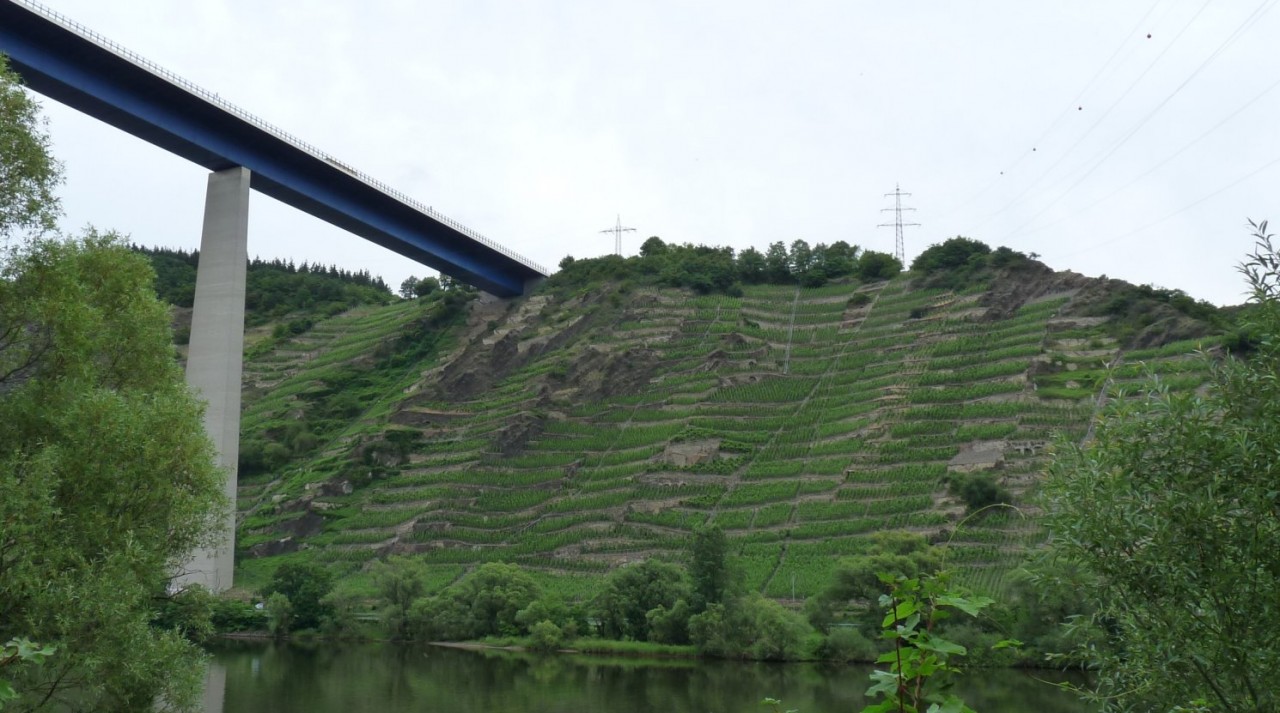
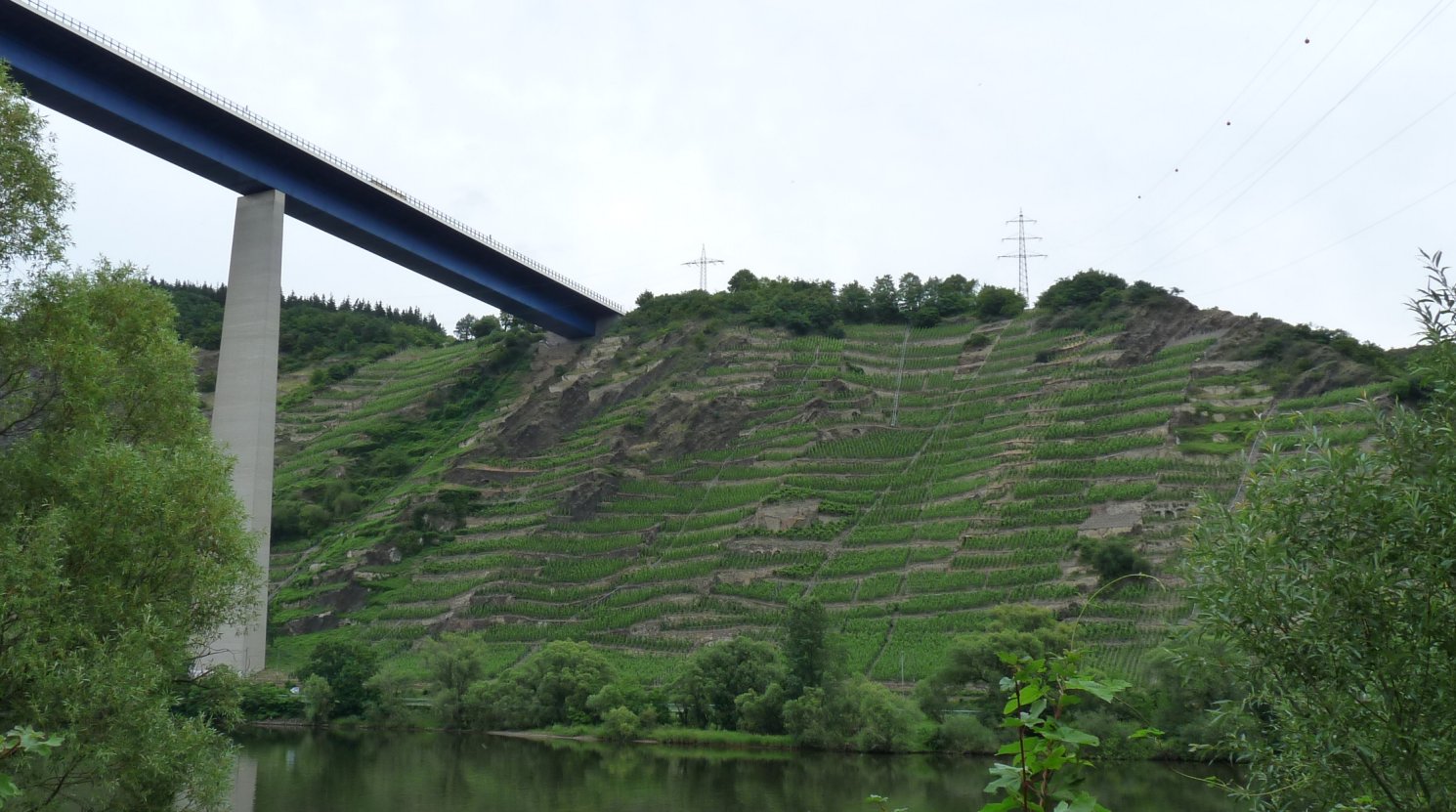
First sight of the precipitous Mosel Vineyards was just past Koblenz on the river road, where the Moseltalbrücke loomed over the valley walls – impressive in a practical, imposing way (but a hint at what may become of the upper Mosel if the new Hochmoselbrücke goes ahead). 

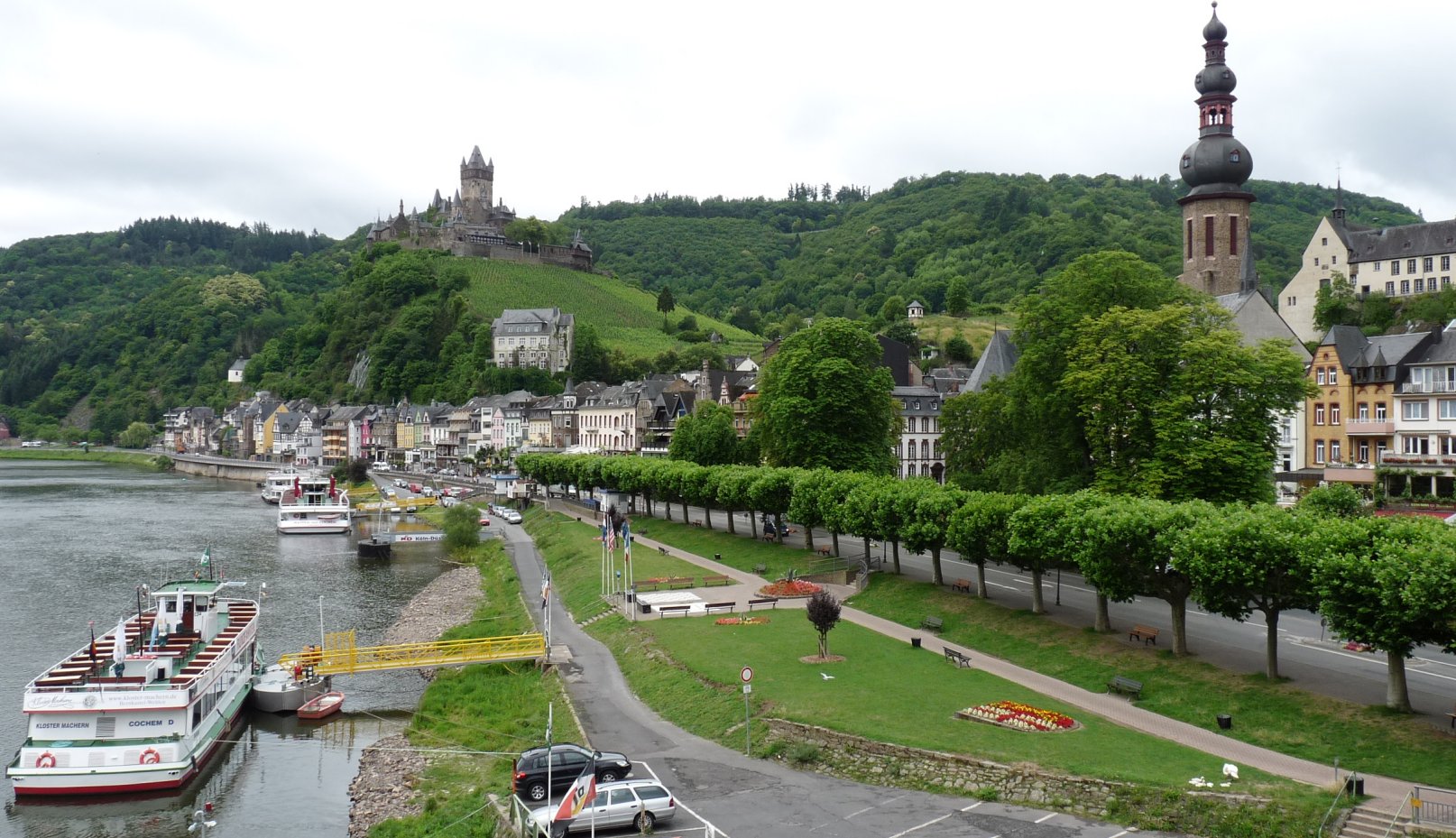
A little while later we were in Cochem, a charming town and a perfect place to spend the evening, especially as the storm clouds were gathering. After checking into the guesthouse, Pension Gundert (well worth a stay at just under €40 a night) we walked into town as the heaven’s opened, ducking into Weinstube Restaurant Beim Weinbauer where an evening meal and a glass or three of Riesling seemed like a good idea!
The 2010 Göbel-Schleyer Riesling-Hochgewächs Trocken (Mosel QbA, 11.5%) proved a pleasing accompaniment to my plate of Garnelen und Pasta (Shrimp tagliatelle in a rich cream sauce): The wine had a creamy, lemon sherbert nose, a little spritz on the tongue and a clean, fresh taste. Although there was a touch of sweetness in the mid-palate light it was drier than first suggested, very pleasant indeed for €9.50.

The rain in the evening meant we couldn’t enjoy the guesthouse rooftop terrace (a selection of local wines can be bought at the Pension) so a relatively early night ensued. The next morning the sun was out so a short walk in town allowed a little sightseeing before getting into the car and heading further upstream.

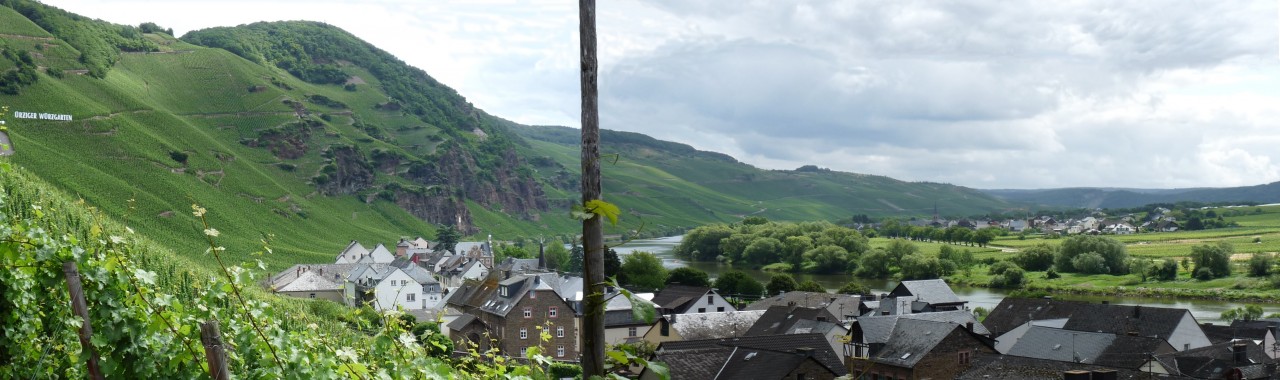
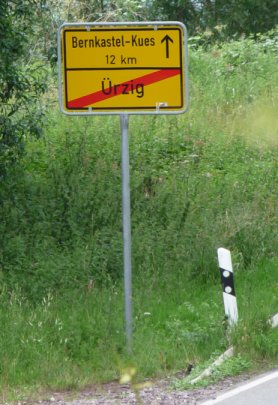
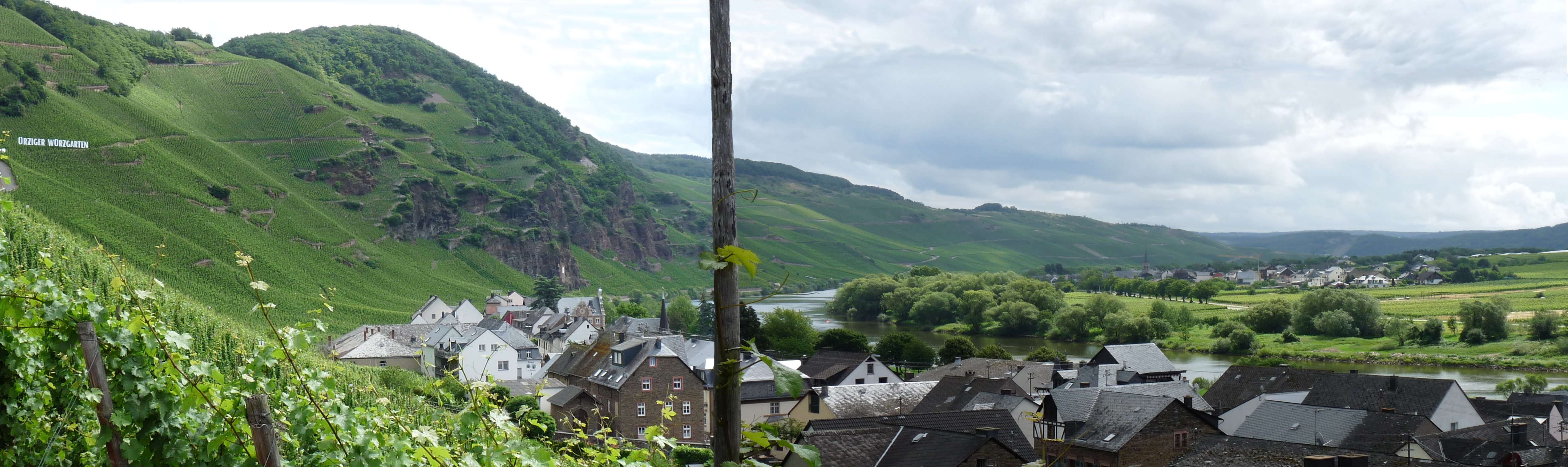
Day 2: We left Cochem on a clear Saturday morning with the BMWs SatNav programmed for Bernkastel-Keus, our evening destination. We then promptly ignored all of its directions as we kept to the old river road following every twist and curve of the Mosel upstream. After a sedate drive with excellent scenery it was around lunchtime that we entered the village of Ürzig, famous for its Ürziger Würzgarten vineyard with its rich red-slate soil (as opposed to the majority of the Mosel which has grey-slate). It’s this “Roten Schiefer” that gives Riesling from this area an exotic spice and tropical fruit complexity.

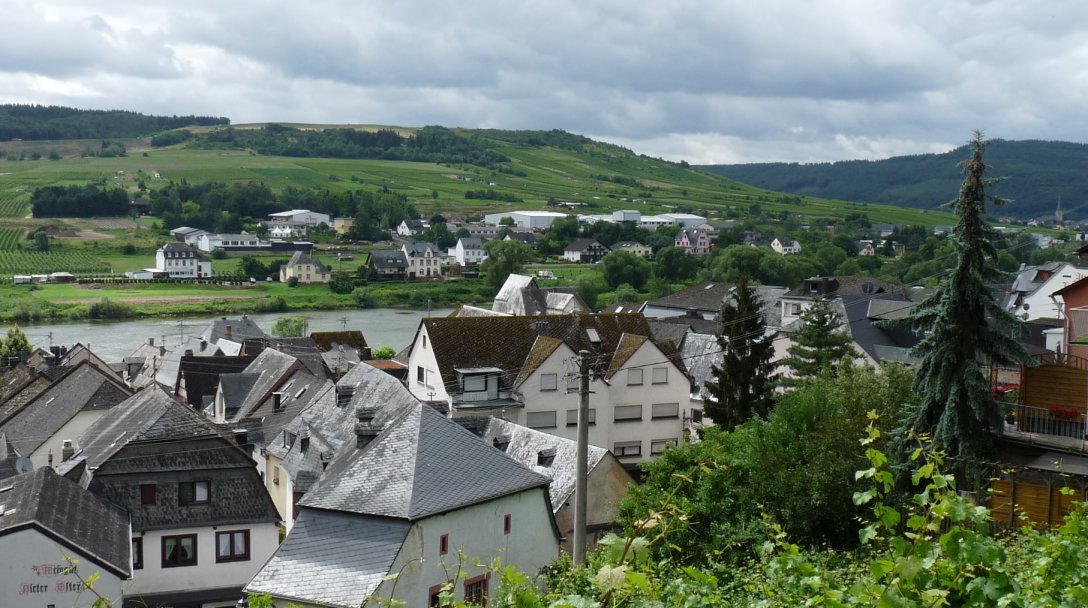
The village is as traditional as you can get – old-style houses on the gradual slope up from the river bank – but it is the vineyards behind the houses that take the breath away. Steep slopes angle upwards in an amphitheatre curving round to the north and east, becoming the most precipitous at the river bend (just before and opposite the village of Erden on the other side) where the red slate is at its most obvious.

Keep turning clockwise and you’re eventually facing southeast where you can see the plateau just behing Rachtig, site of the proposed Hochmoselbrücke. It’s hard to believe how big a change to the landscape this massive engineering project will bring, but for a taster go to the Pro-Mosel Action Group web-site to see mock images of what this pristine area will become when the bridge works finally go ahead.

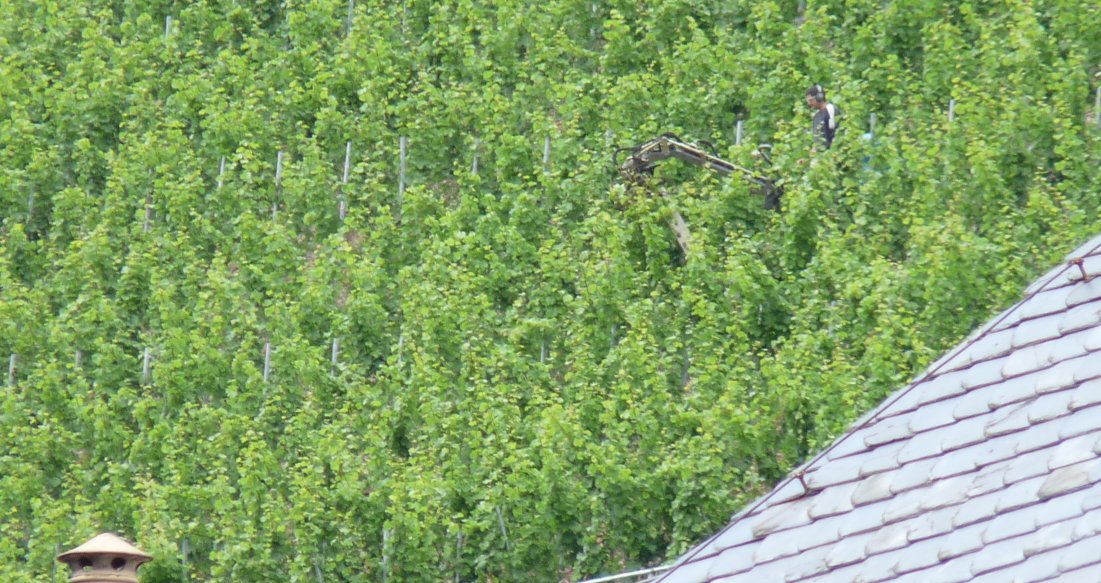
As we wandered about the small back streets and alleyways we saw a tractor high up in one of the vineyards behind the village and noticed a man on some sort of mechanical pruning machine being lowered down, and then pulled back up, one row at a time, giving some idea of the effort needed to tend vines on such gradients (as for harvest time, I can only guess at the back-breaking work involved!).

At the southern end of the village we chanced upon an oddity in this sea of traditionalism, a brand new winery building with angular, freshly painted concrete walls and a tasting room entrance of glass and steel. This belonged to Weingut Rebenhof (literally Vineyard) although, in keeping with the modern lines of the new building, it was pronouncing itself a “Riesling Manufaktur“. As I like contrast and challenging conventional wisdom it seemed the perfect place to have my first tasting at a Mosel winery and, nearly an hour later after trying a dozen wines poured by winemaker Johannes Schmitz himself, we finally left and made our way to a restaurant for lunch.
There will be more on the Rebenhof tasting soon, but suffice to say Schmitz makes some damn fine Riesling!

After a hearty lunch (Bierwurst & Mash was my choice) we finally left this charming village and continued on the road for Bernkastel-Keus, only a few kilometers down the road.

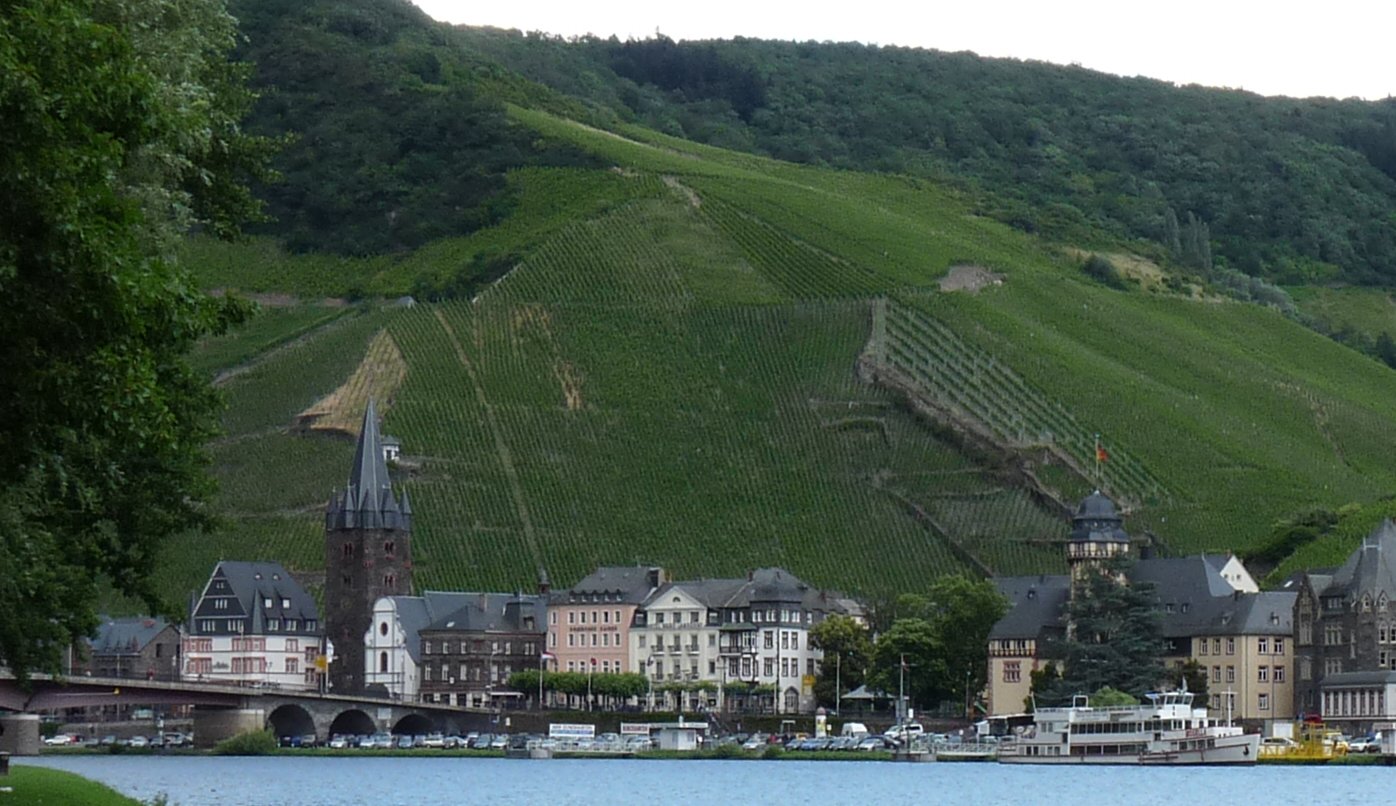
Day 2-3: Following on from our mid-day stop over in Ürzig it was only a few kilometers down the road to Bernkastel-Keus, where we had planned on spending the night. Arriving in town about 3pm it was clear that this was a tourist trap; the roads were significantly busier and there were people on the streets (Ürzig was a ghost town in comparison). Unsure of the local geography I ended up over the bridge at a riverside carpark in Keus on the western side of the river (the left bank) where there was a superb view of Bernkastel’s most prized vineyard – the Bernkasteler Doctor.

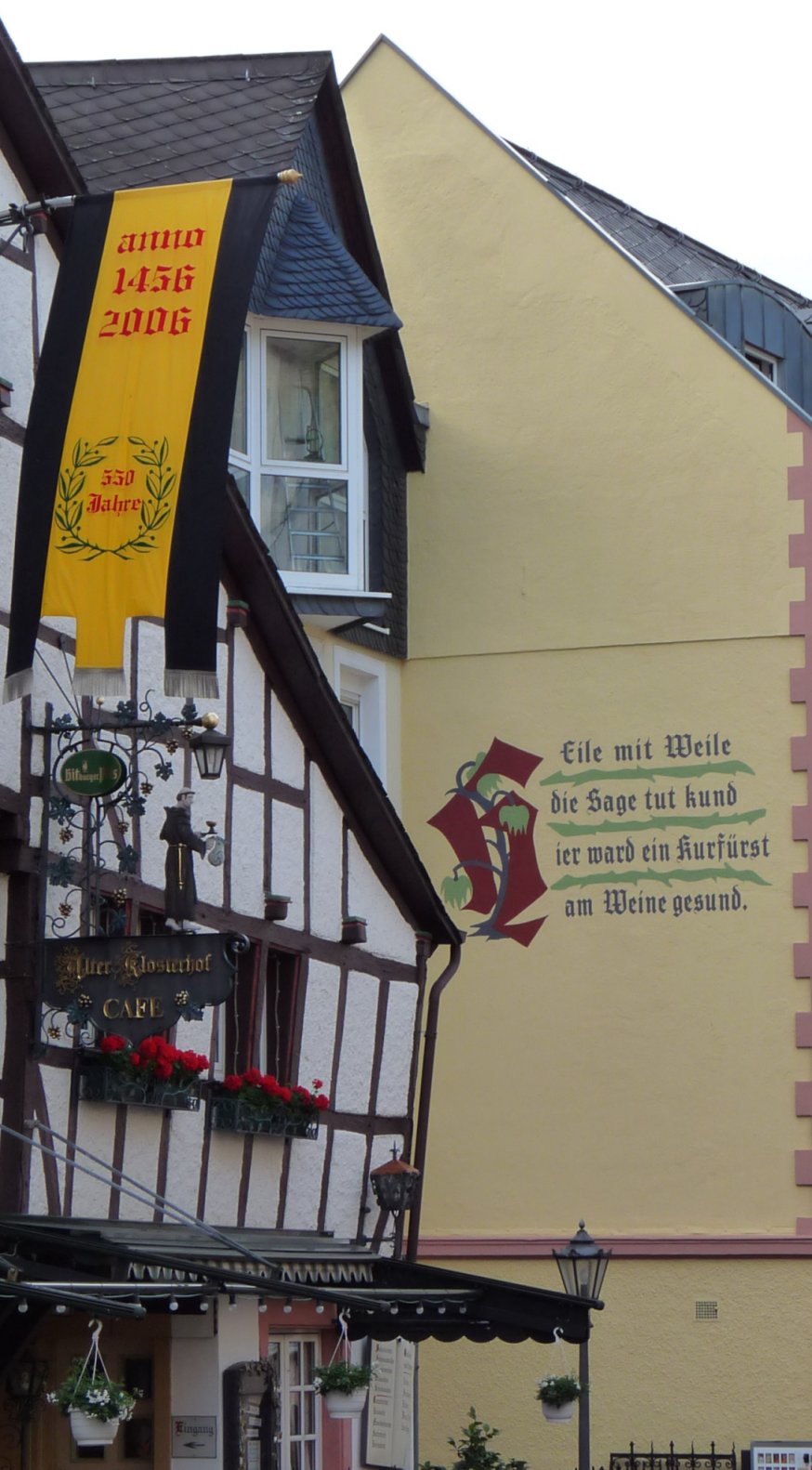
The local legend has it that in 1360, while staying at Bernkastel’s Landshut Castle, Kurfürst (Prince Elector of the Holy Roman Empire) Bohemond II, Archbishop of Trier, was close to death with a fever and all attempts to heal him had failed. A small barrel of the local wine was provided from which the Kurfürst drank deeply, making a full recovery after a few days. The vineyard which produced the wine was proclaimed the best Doctor in the region and the title was maintained ever since (although the 1971 German Wine Laws diluted its reputation by adding on adjacent vineyards in a short-sighted rationalisation of some of the Mosel’s greatest names).

Before any sightseeing could be done a bed for the night had to be found, as nothing had been booked in advance. It was surprisingly difficult to get something (plenty of guesthouses, no single rooms free!) until, after nearly 2 hours of searching I stopped at the Leo Schwab Weingut und Gästehaus on Saarallee which had a room for €50 (actually one of the first places passed, but overlooked as it was thought likely to be expensive for being on the main road). On reflection if I had stopped asking only for “eins zimmer” earlier there were probably plenty of “dopple zimmers” for a similarly low price that would have done the job!
I’d only just got my bags from the car when the heaven’s opened and a torrential downpour killed the chances of any sightseeing for the rest of the afternoon.

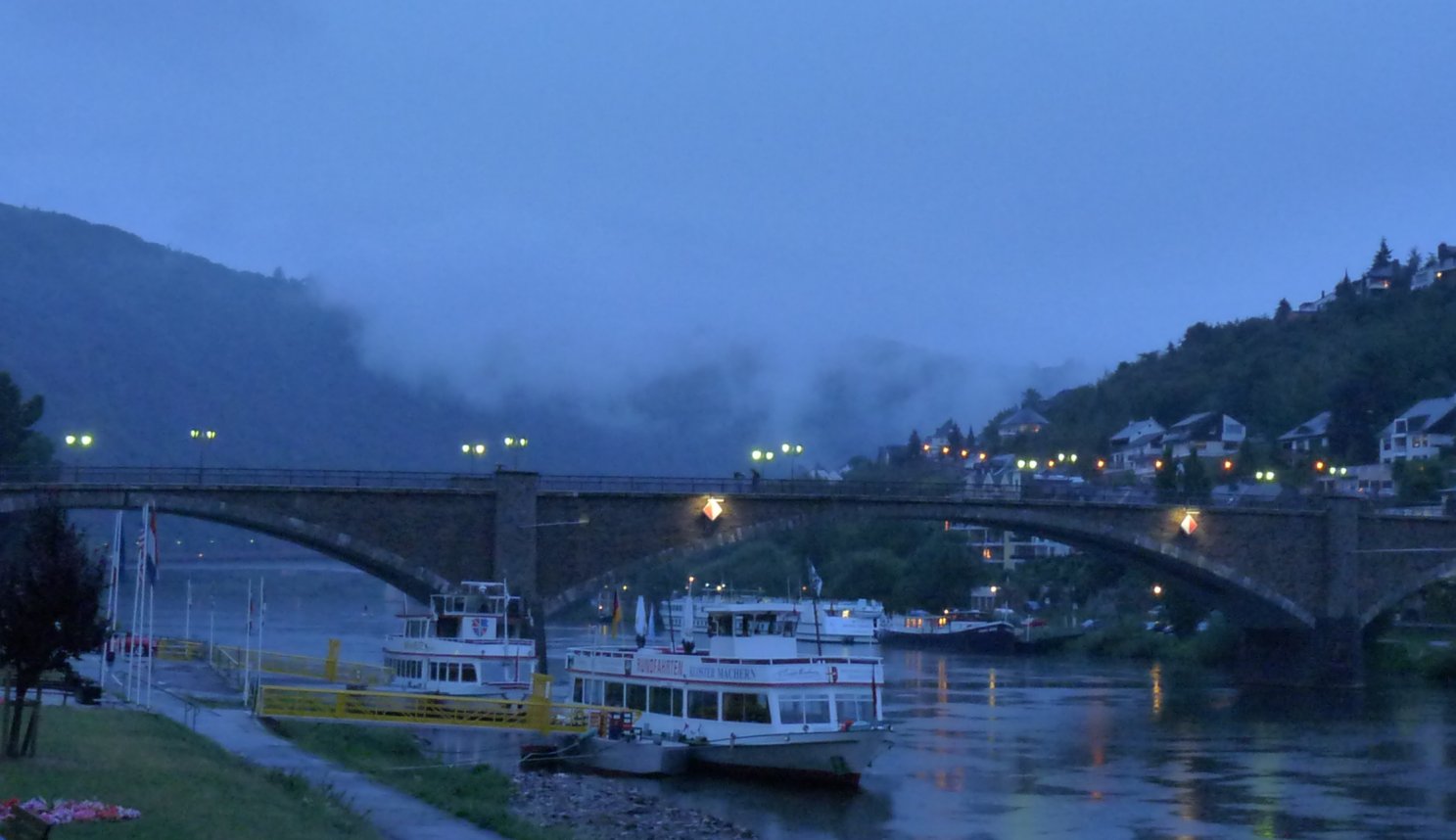
Once the rain had stopped it was early evening and time for a stroll across the bridge into the old town of Bernkastel. Looking downriver I could just make out another famous vineyard, the Graacher Himmelreich, on the right while upstream was the ruined Landshut Castle, destroyed by fire in 1692.

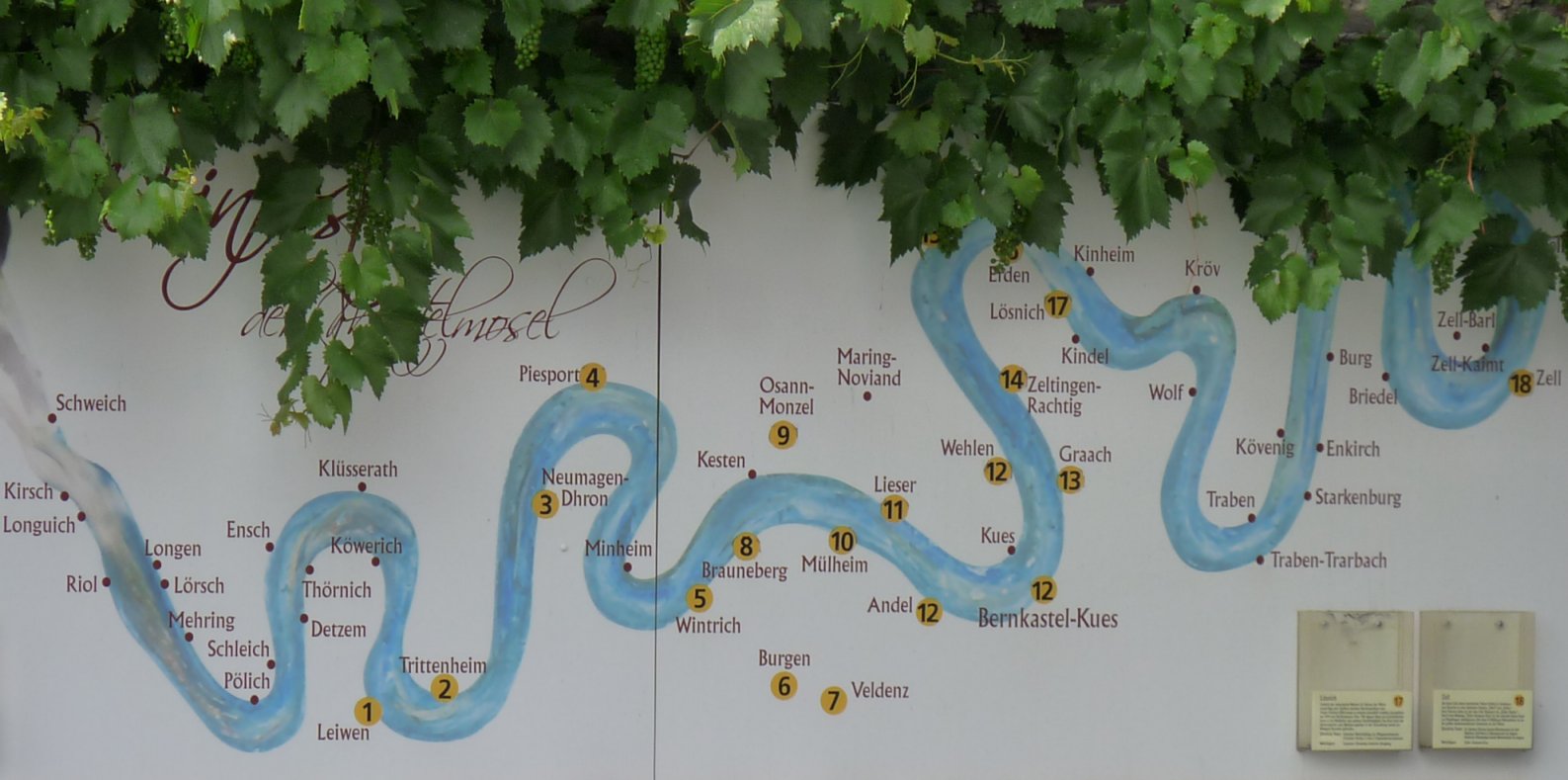
At the entrance to one of the alleyways into the old town was a map of the Mosel and its famous wine towns – Bernkastel-Keus is one of the number 12s, while number 15, Ürzig, is obscured by a vine leaf.

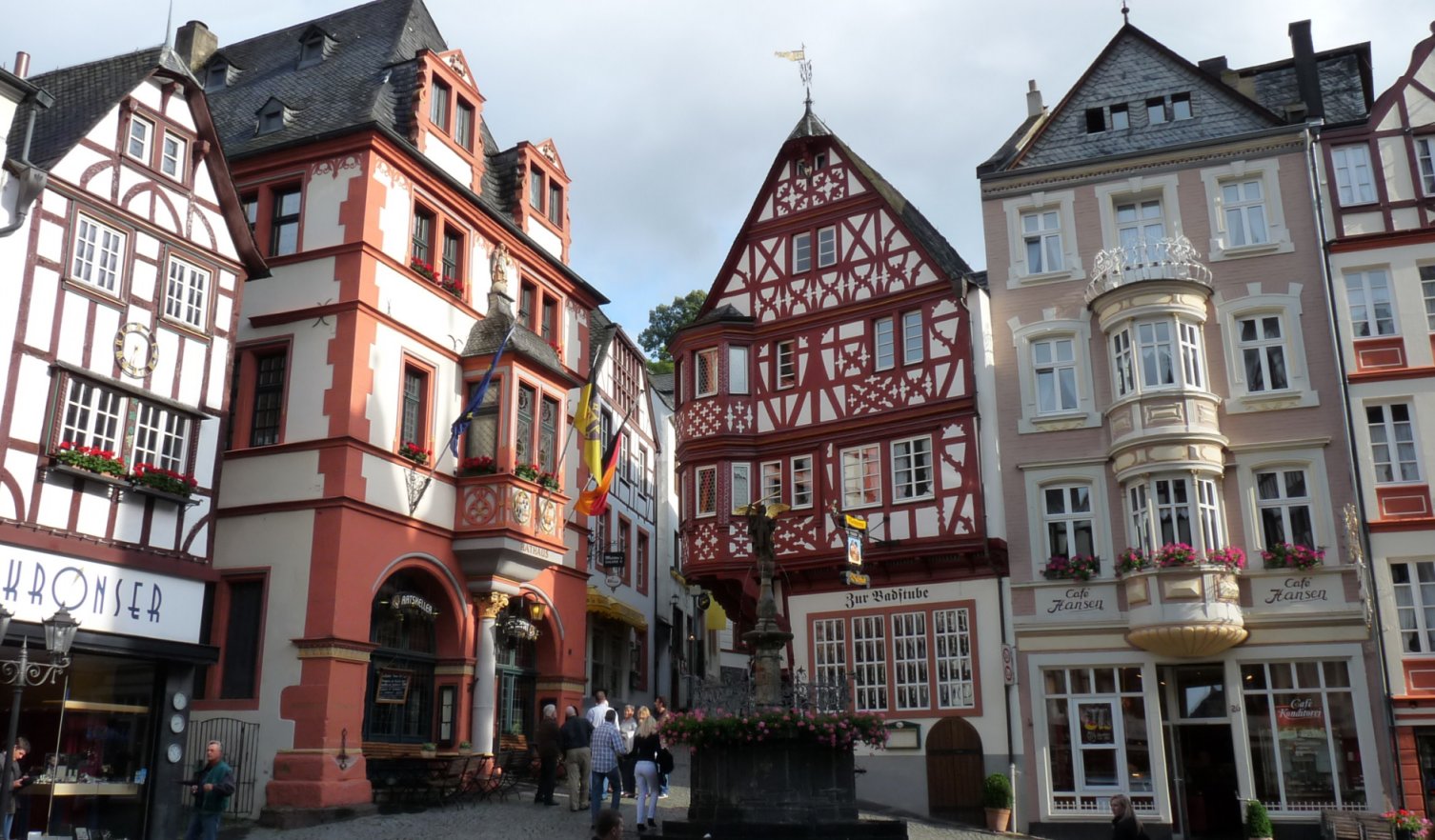
The old town has to be one of the prettiest places I’ve ever seen – a picture postcard step back in time (think of the Vulgarian village from Chitty Chitty Bang Bang!) with open-faced wooden beam houses painted in various colours with pristine whitewashed plaster.

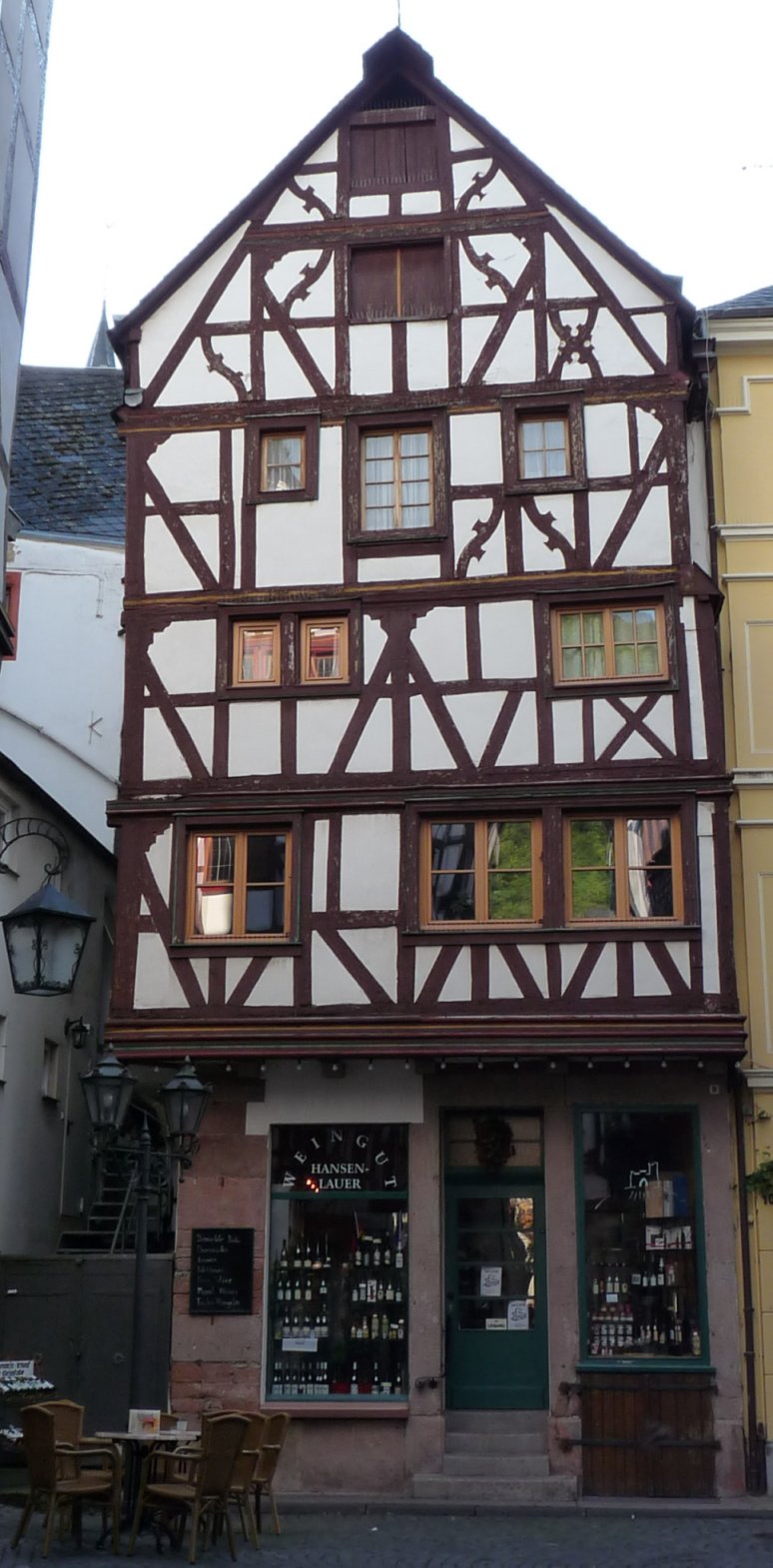
After wandering for a good hour I then found what has to be one of the most picturesque wine shops ever, Weinhaus Adam Lauer. Also intriguing were the bottles of Rebenhof wine they had in the window for exaclty the same price I paid at the winery in Ürzig earlier that day. Sadly the shop was closed (or maybe luckily, otherwise who knows what I would have bought!).

Somewhat perversely dinner was at the only Indian restaurant in Bernkastel (the Taj Mahal – good food, just make sure you ask for the “extra hot” version of any meal on the menu, even then it’ll still be milder than you were expecting) although, to keep in theme, a bottle of Riesling (Markus Molitor 2007 Bernkasteler Badstube Feinherb Kabinett) was ordered. To be fair, and with hindsight, a bottle of Cobra beer would have been a better choice! That brought the evening to a close and it was back to Gästehaus Schwab for a relatively early night.

So ends my Mosel diary, as the next day was a leisurely Sunday drive back heading east to the Rhine, then hugging the left bank back to Koblenz before retracing the route to Wetzlar. The BMW had covered just under 500km and I had my first glimpse of a wine region that I must return to again in the future, as I know I barely scratched the surface.

Prost!

Posted in Wine Regions | Tagged , , , , , , | Comments Off on Mosel Meanderings

Greybeard’s Corner – May 2011

With the Rapture due to decimate the world on May 21st it hardly seemed worth researching this article, but luckily the end of the world has now been postponed until October 21st so we have a few more months to enjoy the fruits of the vine and the worldly pleasures associated with it. Sadly there were several news pieces that initially followed the themes of Disease, Death, Devastation and Destruction.

May got off of to a poor start with the Cancer Council of Australia damning drink with the doom-laden “alcohol is clearly one of the most carcinogenic products in common use”  and launching TV ads in Australia where a spilled glass of red wine symbolises the spread of cancer (the beer and spirits more usually associated with alcohol abuse obviously don’t have the same visual impact) – all of this prompting a written response by the Winemaker’s Federation of Australia. Wine Spectator reviewed the fallout a few days later.

Less than a month after the death of Jess Jackson another Californian great passed away when Mike Lee of Kenwood  succumbed to a heart attack while playing Golf, the Wine Enthusiast paying tribute to his life and times.

There was devastation from the elements in Germany and California as Spring frost hit both side of the globe: Decanter reported on -5oC (23oF)  temperatures at the beginning of May hitting Pfalz, Rheinhessen, Franken and Württemberg vineyards with their worst frost for 30 years while California’s Central Coast gets the same treatment less than a week later, with Paso Robles most severely affected and subsequently Wines & Vines reporting on up to 30% crop loss in affected areas. The California frost actually hit in April, but it wasn’t until May that the media started reporting the news.

Man-made destruction also made the headlines as German politicians pushed the controversial Mosel Bridge plan forward – Decanter summarised the saga so far while Jancis Robinson, a vocal opponent of the plan, re-posted Sarah Washington’s emotional blog piece to the greater wine world. Regardless of the wine world’s distaste it seems inevitable now that the bridge will be built, the vineyards affected will have to adapt and all that is left is to observe.

Luckily there were some less depressing stories to be found as well, starting with the shock news that Vintage 2010 in Bordeaux is very good! UK merchants Berry Bros place it at least the equal of 2005 and superior to the lauded 2009, as reported by Harpers Wine & Spirit.

In the monthly Decanter Magazine their 2011 Power List was published on the 50 top movers & shakers in the Wine World. In a sign of the times I applaud the 16th placed “Amateur Wine Blogger” and 38th placed Eric LeVine of CellarTracker as recognition and acceptance of Social Media and the internet in 21st Century Wine.

More controversial was the furore surrounding the supposed comments of Rhône wine guru Michel Chapoutier who has expanded his interests into Alsace with the setting up of the Shieferkopf label. Decanter sensationally headlined “Petrol smell in Riesling ‘a mistake’” in their short article which lit the fuse for a host of parry & riposte comments (36 to date on Decanter.com, something of a record for them) and in subsequent articles and social media. But how many delved deeper than the inflammatory title to find out that Chapoutier was apparently referring to his views on young Riesling? (which came to light in an interview on Drinks Media Wire – “If some, following my comment on this defect in young Riesling wines, understood that I was talking about old Riesling wines: it has never been the case”). Whether Decanter deliberately omitted the “young” in their article to raise debate, or Chapoutier himself forgot to clarify in the knowledge it would generate significant attention to him (and his wines) I can’t speculate – but someone was definitely playing a PR game.

However if more proof was needed on the joys of Life after Rapture then where else to look but the heart-warming news of the twin girls born to Gina Gallo and Jean-Charles Boisset (both of whom appear in the Decanter power list at positions 15 and 25 respectively) announced in Wine Spectator as the month drew to a close – I’ll raise a glass to the continuing health of both daughters and parents.

And so to my little corner of the world where one local retailer dominated proceedings – Richard Granger based in the Jesmond area of Newcastle. Manager Alastair Stewart prepared a thoroughly informative tasting for the May NEWTS meeting focussing on North East Italy, before hosting a Spanish tasting at the store the following week.

For the NEWTS there was a representative range from Trentino Alto Adige, Friuli Venezia Giulia and  Veneto with both indigenous & international varieties covering modern and classical styles, starting with a just-interesting-enough Prosecco Donna Trevigiana from Valdobbiadene as an aperitif. Out of the 8 red and white wines tasted there was an example in each colour of a great value drinking wine and a superb wine but at a price most would walk away from.

QPR in white was represented by the Monte del Fra Custoza 2009, a mixing bowl of Garganega, Trebbiano Toscano, Tocai Fruilano and Cortese (with a soupçon of Chardonnay, Riesling Italico and Sauvignon for good measure). This wine was the well balanced sum of its many parts; herbal and floral aromatics, medium-full bodied with good structure, a little oily, a little sweet, a little dry and a little bitter, leaving a textured finish on the palate. It was exactly my style of interesting and unusual for only £9.42.

The Pieropan La Rocca 2008 Soave Classico, on the other hand, was an example of a great Italian white at an equally “great” price, £23.82. This single vineyard gives late harvested Garganega is fermented and aged in large oak casks, giving a long-finishing, citrus themed, multi-dimensional wine with layered complexity and texture over flavour. Comparisons to Condrieu were made, which seemed appropriate for the price as well!

QPR in red went to the Tenuta Lena di Mezzo 2007 Valpolicella Classico Superiore Ripasso (also from the Monte del Fra stable). This had a mature nose suggesting acidity and a rich, slightly sweet taste with a hint of raisins. Mocha tannins quickly become evident and on the mid-palate a bitterness joins in through to the finish, but in good balance with all the other components. At £13.86 it may seem pricey for a good value wine, but for me this was into 4 star territory and therefore a bargain!

Also in that 4 star zone was the final wine of the night, the Ripasso’s big brother – the Tenuta Lena di Mezzo 2005 Scarnocchia, Amarone della Valpolicella Classico. I adore Amarone so this was always going to be popular with me, but the quality shone through as soon as I took a sniff of the beautiful enamel, smoke and baked chocolate aroma. In the mouth it was luscious; perfectly balanced with well integrated bitter tannins offset by a dense richness. This was a powerful, taught wine although still young – I’d give it at least 3 more years before trying the inky black juice again – however, as you’d expect from a single vineyard Amarone aged for over two years in oak, then another year in bottle before release, this was never going to be cheap and the £44.58 price tag meant that everyone in the room would have taken 3 bottles of the Ripasso instead with change to spare.

I met Alastair again in his compact but cosy store just over a week later for one of the regular Richard Granger tasting evenings, this time trying 9 dry wines from Spain accompanied by Spanish themed nibbles to reinforce the sound principle that most wine is made for enjoyment with food.

2 delicious Albariño from Bodegas Martín Códax (who was a 13th century Galician minstrel) showed the quality of this grape and region; both wines giving a creamy mouthfeel with a clean citrus taste but with the 2008 Organistrum (named for a curious 2 person musical instrument) raising the flavours to a higher level and showing a deeper honeyed nose with richer, longer finish. The Organistrum has a 3 month malo-lactic fermentation in oak which makes it my first ever wooded Albariño, although the use of oak was well handled and not overtly evident in the taste. Unfortunately both wines suffer from the effect of Albariño’s popularity and rarity: a price that often doesn’t match the relative quality. Here £11.52 and £19.80 were just about defendable as good examples of the style, but there are many other whites I’d put my money towards first.

Onto the reds and all 5 we tried were well structured wines with generous fruit, each backing up my own feeling that Spanish reds are a relatively safe bet in the £7-£25 range. My favourites were;

  • Museum Real 2005 Reserva from Cigales (£16.02); the archetypal Spanish nose of dark red fruit and sweet oak which was a surprising foil for spicy Chorizo,
  • Marqués de Murrieta 2004 Reserva from Rioja Alta (£18.60); a restrained nose that developed in the glass and an elegant taste with plenty of smooth tannins,
  • Mas la Moia 2006 Priorat (£26.40), more smooth elegance with chocolate tannins and a dash of sour funk” which I appreciated.

The final wine was the Hacienda Monasterio 2005 Reserva from Ribero del Duero, a gentle wine that caressed the palate with subtle textures, but had a fundamental lack of fruit which couldn’t live with its £47 price.

Now on a normal month that would be the end of my local tales, but May continued to give! It was my partner Sarah’s birthday mid-month so a long awaited trip to the award winning Feathers Inn was called for, given that it is less than 10 miles from where I live the fact I haven’t visited before is somewhat criminal. Along with delicious afternoon lunches the pub has a solid and reasonably priced wine list which saw the Chamuyo 2009 Argentinian Malbec match my lamb’s liver main, while Sarah proved patriotic with a glass of Three Choirs “The English House” white with her lasagne – the food and the wine were significantly superior to a meal at the Italian-American Frankie & Benny’s Diner a couple of weeks earlier (where the wine was practically undrinkable).

Good food continued at the end of the month with the NEWTS Spring dinner at the Newcastle College Chef’s Academy, where the three courses were washed down with the member’s own selection of BYO bottles. Although my own offering, the 2005 Château Pesquie Quintessence Blanc, was horribly oxidised there were more than enough bottles to share around and we finished off with a delicious Quinta do Noval 20 year old port bottled in 1973. Even though 20 year old tawny port is ready for drinking when bottled this one had aged gracefully and its hot, rich raisin, caramel and toffee flavours were savoured by all at our table (and a couple of passersby!).

On the home front and I managed to buy in 13 new bottles for the collection, as much as in March and April combined. I’m particularly looking forward to seeing if there’s any life left in a Borgo San Michelle 2000 Taurasi, how the 2008 Au Bon Climat Santa Maria Valley Pinot Noir and the 2007 Van Volxem Alte Reben Saar Riesling compare to their earlier(and delicious) vintages, and whether the 2009 Château Musar Jeune shows any of the character of its more venerable siblings. However, it was mainly  a month of sweeties with a 2001 5-Puttonyos Tokaji Aszu, a 2004 Passito di Pantelleria, the Lustau PX San Emilio and Torres Floralis Moscatel Oro all promising sweet and unctuous enjoyment over the coming year or two.

As for home consumption, 11 bottles contributed to the local glass recycling scheme, sadly two of them spoiled (along with the oxidised Pesquie a decidedly corked South African red from Noble Hill). Luckily two bottles stood head and shoulders above the rest, both from California.

First was the Destino 2007 Late Harvest Viognier from Lodi, a divine dessert wine with a nutty, baked fruit aroma, a strong butterscotch flavour with a little honey, candied stone fruit and a thick textured which coated the mouth leading to a very long finish. Four stars all the way this was in 92-93pts territory and easily the best sweet wine I’ve had, sadly relegating a Tokaji Aszu into second place!

Our second notable Californian came from Mr Eclectic himself, Randall Grahm, in the guise of the Bonny Doon 2003 Cigare Volante, but is also a lesson in the mysteries of wine development. On first opening this had a funky, slightly sweaty nose with a little stewed fruit (it also had a thick plug of sediment in the neck which required scooping out with a spoon handle!) and a lean, almost green taste with alcohol heat on the finish. My first reaction was that it was over the hill by a year or two, and it didn’t really change much over a couple of hours. Fast forward 24 hours later (a large part of that with the bottle in the refrigerator) and suddenly the whole thing had opened up; the nose was an enticing light tobacco and spice while sweet fruit and much calmed tannins caressed the palate (yes, I know I’ve already used that once already, but it is as apt here as well). I could scarcely believe it was the same wine, now heading towards 4 stars – what a difference a day makes!

Cellar trivia alert! Drinking the Destino and Cigare Volante have reduced my Californian wines to 6 bottles (including the Au Bon Climat just bought), three of which were purchased at the cellar door during my trip to the Golden State last year. This makes up barely 4% of my collection and suggests I need to do something about this, even though decent US wines are relatively expensive in the UK.

Time to polish my crystal ball and peer into the temporal ether. I predict that early readers of this article will have time to consider visiting San Francisco for Pinot Days between June 13th – 18th featuring wines from more than 200 Pinot Noir producers. Nearby and the 31st annual San Francisco International Wine Competition will be going on over June 17-19th, although you probably won’t recognise any of the judges in the street. June 14th – 16th also sees Southern California host the 8th annual California Wine Festival in Santa Barbara (remember your sun-block).

Over in Europe and the big trade event  is in Bordeaux, where Vinexpo 2011 runs between 19th and 23rd June. This year Italian wine seems to be getting the lion’s share of exposure in the programme.

Moving into July and back to California when the 16th sees Passport Day for the Wineries of the Santa Cruz Mountains, with more than 50 wineries in the passport program from Half Moon Bay to Gilroy.

If you’re planning on attending any of these events I wish you a safe journey.

Slainte!

Greybeard

Originally published June 7th, 2011 on Reign of Terroir

Posted in Greybeard's Corner | Tagged , , | Comments Off on Greybeard’s Corner – May 2011

A Taste of Germany…a NEWTS tasting

Over a year ago I put my name down to give one of the monthly tastings at the North East Wine Tasting Society (NEWTS) and chose Germany as my theme. If you mention German wine to a random group of people you’ll likely get one of the following negative responses;

  • “Never touch the stuff, I remember the 80s; cheap and tacky!”
  • “The most incomprehensible wine labels in the world; can’t read them, can’t pronounce them, don’t buy them!”
    …or maybe,
  • “Eugh, Riesling! Smells and tastes like sweetened engine run-off!”

The stereotypically negative responses are all the more painful if you are aware of Germany’s rich wine history stretching back over a thousand years. During the 18th and 19th centuries the top German wines were more sought after (and more expensive) than those from Bordeaux, but vine disease, economic depression and war all took their toll so that by the 1980s the German fine wine industry had collapsed and been replaced by an expanse of low quality grapes producing cheap, sugary offerings such as Liebfraumilch, Piesporter Michelsberg and Blue Nun. Although these do not feature further in this piece I urge you to read TheWineRambler post from earlier this year where this infamous trio go head to head in a blind taste-off!

The good news is that most of the best vineyard sites are still there creating some of the world’s greatest white wines and, if you’re lucky, you will find a like-minded soul who has had their Riesling epiphany – but what about taking the question further and asking about that most mythical of beasts, German Red wine?
Give the most hardened naysayers a few minutes to recover from fits of laughter and then collect the answers; 

  • “Did you mean to say red?”
  • “I prefer tannin to sugar you know!”
  • “There’s only so much thin, acidic wine I can drink”

Maybe, just maybe, you’ll get “I hear they make the odd decent bottle of Pinot”, which is something I’ve touched upon in my 2008 post Better Spät’ than never, but that response will be limited to the more informed wine enthusiast, even though planting in Germany increased in the 1990s and 2000s so that now about 35% of the country’s 100,000 hectares (247,000 acres) of vineyards are devoted to red grapes.

To make my first ever tasting even more difficult I’d vowed that it wouldn’t just be a night of Riesling but would be a representative range from the world’s 8th largest wine producing nation covering the key styles, regions and grapes yet keeping within the constraints of a limited budget and 10 bottle maximum. My challenge, therefore, was to find wines that could stand up to the critical palettes (and stereotypes) of the massed ranks of the NEWTS (famed for their suspicion of whites and thin reds).
In sourcing the wines I was lucky that business trips to Germany last year meant I quickly had the core of the tasting ready but, by the beginning of April, and with only a few weeks to go, I still needed four or five to make up the numbers and provide a backup in case of any faulty bottles. What surprised me was exactly how involved it was to source these final bottles, confirming just how difficult it is to buy interesting German wine in the UK – especially if it’s not Riesling from the Mosel.

I was especially disappointed by my local Majestic store when I walked up to the large “Germany” sign in the corner only to find 5 Rieslings and the rest of the space taken up by bottles from Alsace, Austria and Hungary (the only time those areas were grouped with Germany was during both World Wars, so let’s not analyse that any further!).
Oddbins was not much better, but it did have the excuse of limited shelf-stock due to being in the process of going out of business, and even then it had the Villa Wolf 2009 Pinot Noir which was my last ever purchase from the Newcastle store before it finally shut its doors.
Wine Dancer.com was required to add a bit of sparkle to the evening with the Michael Schäfer Sekt, although his Lieblich Dornfelder sweet red didn’t make it into the starting line-up. Finally a local retailer, Dennhöfer Wines (hidden away in the wilds of Northumberland) came to the rescue providing a quality Pinot Noir and a refreshing Rosé.

So to the evening itself, and we started with an aperitif in the form the Cabinet Gold Trocken Sekt from Weingut Michael Shäfer in the lower Nahe. This been a family business since 1732 and Alfred and Karl-Heinz Shäfer operate a modern winery outside Dorsheim, although the original cellars in Burg Layen are still used for tastings. Like nearly 95% of Sekt this was made by the Méthode Charmat, where the wine undergoes secondary fermentation in pressurised steel tanks (autoclaves) as opposed to bottles, creating a fruitier style than those made in the traditional-method. Frenchman Eugène Charmat championed this on a commercial scale in 1907 with a move away from earlier, wooden tank techniques and the process is also known as Martinotti-Charmat Method or the Metodo Italiano, as it is a common technique for Prosecco production.

The Cabinet Gold Trocken was an unidentified blend, probably of Riesling, Müller-Thurgau, Silvaner, Weißburgunder and Scheurebe varieties which are grown on the 15ha Shäfer estate. At 11% abv we expected it to be simple and sweet, so were pleasantly surprised by a satisfying fruity wine with some depth and dryness, compared to a good Cava by some in the room. It was described as “not really Trocken” and some thought the bubbles disappeared quite quickly, but even then it was pleasant enough to drink and was generally liked by the group, especially at £8.96 (from Wine Dancer in the UK).

We then moved onto the 2004 Ockfener Bockstein Riesling Kabinett from Weingut Reichsgraf von Kesselstatt, an estate with a history spanning more than 650 years since the von Kesselstatt dynasty migrated to the electorate of Trier in the 14th century – the first documented vineyard purchase dates from 1349.
Although based in Morscheid in the Mosel the Weingut has 36ha of vineyards spread evenly over the Mosel, Saar and Ruwer river valleys, 98% which is Riesling –it doesn’t come any more traditional than this with their range embracing the Prädikat system and tending towards the off-dry styles.
The Ockfener Bockstein vineyard is one of the Saar’s steepest south facing slopes stretching upwards from a height of 180m (590ft) to 320m (1,050ft), its Devonian slate soils protected by a forest at the top of the valley which acts as a natural irrigation system to reduce vine stress in dry weather.

2004 has been described as benchmark for a normal, classic German vintage, with high ripeness levels and lively acidity, prime for ageing. At 8.5% abv the 100% Riesling Kabinett had a wonderful honeyed nose, slightly floral with typical petro-chemical aspects. There was a richly textured, oily mouthfeel, slightly sweet with some apple and maybe a hint of noble rot. Although it could have done with a touch more acidity it was well balanced and well liked by the group, “it reminds you of how good German wines can be”. What raised more comment was the price, only £7.49 from the local Co-operative supermarket (although that was reduced from £9.99, but even then a ridiculously low price for such a good wine).

We stayed in the Saar for the next wine, the 2006 Alte Reben (old vines) Riesling from Weingut Van Volxem in Wiltingen, just downstream from Ockfen.
The estate is located on the site of a Jesuit monastery and owned by Roman Niewodniscanski, the half-Polish heir to the Bitberger brewing dynasty who purchased it in 1999 after four generations of Van Volxem family management. His 42ha of organic vineyards are also some of the steepest in the Saar (as is the man himself, standing nearly 7 feet tall) growing Riesling and a small amount of Weißburgunder. Grapes for the Estate Riesling come from 30 year old vines, mere babes compared to the 50-100 year old vines used for the premium labels – there’s even a small amount of ungrafted, 120 year old, pre-Phylloxera Riesling.

The story goes that Niewodniscanski bought some of the best terroir in the area using 19th century tax maps which showed the top vineyards, many of which had been forgotten about, and he claims to be guided by such wines as Henri Jayer Burgundies and those “made in Germany a century ago when our wines were worth three times as much as top red Bordeaux”. Unlike von Kesselstatt he’s given up on the Prädikat system, instead making low-yield wines from late-harvested grapes using natural yeasts and spontaneous fermentation through to relative dryness. The results are “harmonic dry” wines – ripe and low in acidity, never over 12.5% abv and completely different to the classic Mosel style with extended lees contact and oak barrel maturation.

2006 is known as the year of botrytis in the Mosel with an early harvest and a small crop, with better acidity levels and higher sugar readings than previous comparable vintages.
At 12% abv the 2006 Alte Reben we had (simply labelled as Saarweine GrossLagen) and had a slightly closed nose of lychees and honeyed raisins, but in the mouth was wonderfully complex; clean, dry with creamy apricots and stone-fruit bitterness. A popular wine with the group this came from local retailer Richard Granger at just over £14 a bottle.

A change of region, grape and style next, with the 2007 Illusion Eins by Weingut Meyer-Näkel from Dernau in the Ahr, the smallest of Germany’s 13 wine regions (Anbaugebiete). The original Meyer estate was founded in 1870 but it wasn’t until 1950, when winemaker Willibald Näkel married Paula Meyer, that the Meyer-Näkel name was created, quickly becoming a pioneer for a new breed of German dry red wines. Although trained as a teacher Willibald’s son Werner took over winemaking in 1983 and has developed the 15ha estate so that it now is probably one of the most famous Ahr producers and has an international reputation for award winning Spätburgunder (aka Pinot Noir).

The wine we tried was a Spätburgunder, but not a red one – instead it was a Weißherbst (white autumn) where single variety, Prädikat quality red grapes are gently pressed and fermented without skin contact. This creates a light, delicately coloured wine often described as a type of Rosé and popular in Germany, although the Illusion Eins had barely a hint of colour.
Although 2007 has been described as a classic Ahr vintage producing elegant wines unfortunately the group were quick to pick up on hints of oxidation and an excess of sulphur reduction. I quite enjoyed its tart, lemon biscuit aspect, but comments of a hollow middle and a short, dry finish showed I was in a minority here.
This was the first of the wines I’d bought in Germany last year from Weinhaus Fehser in Heidelberg at €15 (£13).

We shifted regions again and moved onto a more traditional Rosé next with the Villa Wolf 2009 Pinot Noir Rosé by Weingut J.L. Wolf of Wachenheim, Pfalz.
Founded in 1756 by Johann Wolf, the estate flourished in the 19th Century but mirrored the fall of the German wine industry in the 20th until 1996, when renowned Mosel winemaker Dr. Ernst Loosen took over the winemaking and halted the rot. The 16ha vineyards are predominantly Riesling with 10% of Pinot Blanc, Pinot Gris, Pinot Noir, Gewürztraminer and Silvaner.

2009 was a great German vintage in the Pfalz, Germany’s largest Anbaugebiete, producing ripe wines. This showed through in the Villa Wolf Rosé which had a sweet, red berry nose with a little toffee and spiced cinanamon, while the flavour had some forest fruits and a creamy mid-palate. The wine was purchased from Northumberland based Dennhöfer Wines at £7.82 a bottle and comments from the room were favourable, with comparisons to a Provençal rosé, although I found the fruit a little confected and there was a noticeable harshness on the finish which detracted.

Our first red was a Schwarzriesling Spätlese Trocken by Wein & Sektgut Bernd Hummel of Malsch in northern Baden, Germany’s warmest wine region. This is the only German Anbaugebiete situated in the warmer E.U. wine growing zone B and stretches 125 miles from just above Heidelberg in the north down to Basel on the Swiss border.
Economist Bernd Hummel took over his father’s estate in the Kraichgau, south of Heidelberg, in 1984 after travelling the world, focussing on reduced yields and organic viticulture. He has 9ha of vineyards with 50% Spätburgunder and a mélange of other grapes including Weißburgunder, Schwarzriesling, Lemberger, Pinot Gris, Chardonnay, Riesling, Auxerrois, Cabernet Sauvignon, Cabernet Mitos, Dornfelder and Regent! 70% of his production is red, typically with oak cask fermentation and 2 year barrel ageing before release.

We tasted mixed vintages (2005 and 2006) of Schwarzriesling, which literally means black Riesling but is actually Pinot Meunier (aka Müllerrebe) — not typically seen as a single varietal red. This was an interesting and well received wine with a smoky, cherry nose and a light but elegant flavour including cherry, caramel and a little tar. There was not a great deal of difference between the 2 vintages apart from the alcohol; with the 2005 coming in at 13.5% and the 2006 at 12.5% reflecting that years comparatively shorter harvest due to autumn rains.
This was another of my Heidelberg purchases from Weinhaus Fehser, this time for €12.10 (£10.50).

We stayed in North Baden for the 2008 Heidelberger Herrenberg Spätburgunder S from Weingut Hans Winter in the suburb of Rohrbach, inside the old town of Heidelberg where the family has lived since the middle ages. Although vineyard documentation only dates back to 1749 the Winters consider themselves the oldest winery in Heidelberg with 15th and 16th Century cellars – the ancient Heidelberger Herrenberg vineyard itself is said to date back to the year 766! Although managing 14ha of vineyard only 4ha goes to produce their own label wines, primarily white varieties such as Riesling, Müller-Thurgau, Weißburgunder and Grauburgunder. For their red grapes traditional winemaking methods are used with fermentation on the skins and ageing in old oak casks or barrels.

At 14% abv the dry Spätburgunder had a touch more body and depth to the previous wine, showing a lovely fruity nose with a hint of spice. It had a good mouthfeel with juicy fruit at the front, a mid-palate of bitter cherry and a tannic finish with claims of beetroot from some in the room – a popular wine and the last of my Winehaus Fehser selection at €12.50(£10.99).

Baden had one more red to offer the tasting, although this time we moved much further south to the town of Vogtsburg-Bischoffingen and Weingut Johner, with their 2007 Estate Pinot Noir.
Karl Heinz Johner studied Oenology and Viticulture at Geisenheim before becoming winemaker at Lamberhurst Vineyard in Kent, where he experimented with sparkling wine production. He returned to Germany in 1985 to set up his own winery and continued to experiment, making concentrated, barrique aged wines so different to the norm that the they could only be sold as table wine. Since then Johner has avoided the traditional Prädikat system with all wines bottled with a screw-cap closure and no references to vineyard site, although the reserve wines are identified with „SJ” (Selektion Johner). He then felt the need to challenge himself further and set up Johner Estate in New Zealand where he now spends most of his time, leaving the running of Weingut Johner to his English-born son Patrick.
The 16.5ha estate grows similar amounts of Pinot Noir, Pinot Gris and Pinot Blanc along with some Müller-Thurgau, Chardonnay and Sauvignon Blanc on the terraced vineyards on the edge of the Kaiserstuhl plateau on the opposite bank of the Rhine from Colmar in the Alsace.

2007 was a very good vintage for Baden and this showed in the complexity and balance of the wine. It had a savoury, mushroom nose and a creamy texture with some redcurrant fruit and a clear burst of acidity throughout. The quality of this wine stood out and comments included “a classic Pinot” and “a delight to taste” – many admitted that they would not have considered it from Germany if tasted blind. This wine sparked an interesting discussion in the room, however, the price tag of £19.54 from Dennhöfer Wines was still a surprise to some even though it was served at a recent Ambassador’s dinner In Newcastle.

The final red of the night was a first for everyone in the room, the Chapeau vom Dalberg No. 19 2008 Acolon by Weingut & Sektkellerei Dalbergerhof Strauch in the Rheinhessen, our 6th and final Anbaugebiete of the night.
The winery is based in Osthofen on the river Seebach, a very short river that flows for only 9 km before emptying into the Rhine just downstream of Worms. There is very little information available on the producer other than it owns several stores across Germany which sell only Dalbergerhof wines, this bottle I’d got from the Weinhaus am Grindl in Hamburg for €20 (£18).

In case you haven’t figured it out Acolon is the grape variety, an early ripening cross of Blauer Lemberger (aka Blaufränkisch/Kékfrankos) and Dornfelder created in 1971 and officially recognised in 2002. Although initially limited to 79ha of experimental sites it is becoming established as an option both in and out of Germany, with the variety used in Belgium (Château Bon Baron) and also authorised in England (New Hall Vineyards in Essex has about 2.8ha).

2008 was not a good vintage in the Rheinhessen but this organic wine still managed a ripe 14.5% abv. On the nose there was some sweet fruit, plum (guava was shouted across the room) and raspberry but also a hint of acetate making it a little medicinal. It was easy drinking with fine yet persistent chocolate tannins and syrup of figs in the flavour. A scathing “international fruit driven wine” was heard, although many enjoyed its simple pleasures.

And so to the final wine of the night, again from Rheinhessen but this time another switch in style to the late harvested 1999 Huxelrebe Beerenauslese by Weingut Schales of Flörsheim-Dalsheim. This is another family business going back 8 generations to 1783 and something of a sweet wine specialist, having seen a record 56 Eiswein harvests in their 228 year history.
Their 60ha of vineyards include Riesling, Grauburgunder, Müller-Thurgau, Weißburgunder and a mix of other varieties including the Huxelrebe, which is another grape creation, this time by the famous Dr Georg Scheu who crossed Gutedel (Chasselas) and Courtiller Musqué (Muscat Précoce de Saumur) in 1927. It was named after viticulturalist Fritz Huxel who was the first to cultivate it extensively and received varietal protection in 1969, being grown primarily in the Rheinhessen and used for sweet white wines that typically reach Auslese standards in average vintages – 1999 was such a vintage with September rains diluting acidity and quality.

The Beerenauslese had a mango nose and I enjoyed its tart tatin acidity, although some questioned its freshness and said it was “a bit flabby”. Overall though it was a decent sweet wine to finish the night on, especially with a price tag of only £11.99 for the 500ml bottle from another local supermarket, Robbs of Hexham, back in early 2010.

So there we have it, a whistle-stop tour with 10 wines from 6 Anbaugebiete, 5 grape varieties and 7 styles covering much of what Germany has to offer. The most impressive wine of the night by far was the K.H. Johner 2007 Pinot Noir, but even the simpler wines had many in the room questioning why they don’t drink more German wines. I think some prejudices were broken, although the biggest hurdle remains the lack of availability of all but a handful of Rieslings in the UK, something that won’t change until the average consumer starts to see beyond the sweet sugar water wines from last century.

Prost!

Greybeard Originally published May 22nd, 2011 on Reign of Terroir

Posted in NEWTS Tastings | Tagged , , , , | 1 Comment

Greybeard’s Corner – April 2011

Spring takes hold in the wine world with the unsurprising news that Bordeaux is superb again, Oddbins goes through its final death throws and California sees the resurrection of an historic name.

The big news of last month was En Primeur in Bordeaux; the usual circus of scoring wine designed for years in the bottle based on a taste of some embryonic barrel sample barely finished fermentation. The general consensus seems to be that 2010 is an excellent year for White Bordeaux and the Cabernet grapes, Sauvignon and Franc, but merely very good for Merlot and the Sauternes (with Barsac outperforming its more famous neighbour). Alcohol levels are up and the 2010 reds will probably need more ageing compared to the ‘09s with high tannins but balancing acidity.

My pick of the reviews includes James Suckling’s succinct summary, Wine Enthusiast’s four part diary posting and  Decanter on-line’s breakdown of the right-band and left-bank plus 5 year vintage comparison of the major Châteaux.

Over the English Channel and the demise of Oddbins was completed when Whittal’s, part of Raj Chatha’s European Food Brokers (EFB) group, bought 37 stores in Scotland, London and scattered middle & south England sites as April drew to a close – Jim Budd posted the “Welcome aboard” letter to the lucky survivors on his blog. At the same time the much reviled Simon Baile, Oddbins previous owner (and many would say instigator of its downfall) was looking to buy a small number of stores in the South of England from Administrators Deloitte. Unfortunately, for the remaining stores, the end had finally come and, over the long Royal Wedding weekend, they closed their doors for good with Twitter providing a range of images showing the emotions in play across the country, as shown by the montage image.

As I’ve managed to sneak in a reference to the nuptials of Prince William and Kate Middleton then I can also link to Eric Asimov’s positive piece on English Sparkling winesin The Pour, although his prediction was off as it was Pol Roger NV Brut Réserve Champagne served at the wedding reception.

Over to the US and Inglenook is set for a comeback as the Coppola  Estate announced the purchase of the name from Constellation Brands. Inglenook Vineyards was founded in 1879 by Finnish sea-captain Gustave Niebaum and acquired an international reputation winning medals at the turn of the (20th) Century. Although Coppola has been making his Rubicon wines at the Niebaum property since 1975 the reclaiming of the name finally reunites all the original parts and signals a shakeup of the brand as the announcement also confirmed Chateau Mârgaux’s Philippe Bascaules as Estate Manager and Winemaker, replacing Scott Macleod who retired last year.

Sadly April in California also saw Kendall-Jackson founder Jess Jackson succumb to cancer at 81 – Tim Fish for The Wine Spectator posted a thorough euology on the man and his legacy.

There were two major wine competitions last month with the Decanter World Wine Awards (DWWA) and the International Wine Challenge (IWC) both running at the same time and seeing 85 Masters of Wine (out of the 290 MWs worldwide) descend on London (with approximately a 2:1 ratio for DWWA). Both events were well represented with tweeters and internet wine pundits; the DWWA included Anthony Rose (@antrose33), Robert Giorgione (@robertgiorgione), Jim Budd (@jymbudd) and Jeannie Cho Lee (@JeannieChoLee); the IWC included Tim Atkin (@TimAtkin), Jamie Goode (@jamiegoode), Ollie Smith (@jollyolly), Neal Martin (@nealmartin) and Charles Metcalfe (@thewinesinger). The results of both competitions are to be announced at the London International Wine fair on 17th May.

Back to the UK and a new Budget saw alcohol duty rise 2% above inflation, adding at least another 15p per bottle and meaning that, over the last year, wine prices have increased by about 15%  (including VAT increases) making the UK is the highest-taxed in Europe. To help keep track of how much goes on tax I found an interesting app for the iPhone called “UK Wine Tax Calculator” which shows how much of your purchase is left for the winemaking, marketing and distribution.

With wine prices rising the financial rewards of counterfeiting wine are becoming more lucrative, but it’s not just affecting French wine as Victoria Moore in the Telegraph recounts with the news of Jacob’s Creek being ripped off. Apart from discerning consumers noticing something not quite right with the taste, the fakers didn’t do themselves any favours with the back label declaring “Wine of Austrlia” (sic).

As usual I’ll move the focus up to the North East of England and my monthly wine dabbling. The Oddbins saga had local ramifications as the 2 remaining stores in Newcastle and Gosforth weren’t part of the last minute buy-outs and both closed. Window art this time turned into an advertisement, with Gosforth retailer Carruthers and Kent (run by an ex-Oddbins store manager) benefitting from now being “the only wine store in the village”!

Along with Carruthers and Kent, Newcastle and its environs still has a decent share of independent wine stores scattered around and one I’ve been meaning to visit for a while is “The Wine Chambers” based in North Shields. I’d first heard about young Ben Chambers at a North East Wine Tasting Society (NEWTS) meeting last year and am hoping he’ll do a presentation for us sometime soon, especially after belatedly reading an encouraging article by local wine journalist Helen Savage.

Personally April was also a busy month, including 3 family birthdays and my first ever tasting presentation to the NEWTS as I attempted to show the members that there’s more to Germany than Mosel Riesling. The tasting was well received and can be read about in more detail in my next Reign of Terroir piece, but by way of a teaser we tried 10 wines from 6 Anbaugebiete, 5 varieties and 6 styles covering most of what Germany has to offer, with the most impressive wine of the night a Pinot Noir by Baden producer Karl H. Johner.

As well as buying (and drinking) a fair amount of German wines for the presentation the month also saw a modest increase in both purchases and consumption at home as well, not hard after the very frugal start to the year.

Four reds provided enough interest to mention, starting with the Coppola Votre Sante 2009 Pinot Noir from California – an appropriate choice given the news about Inglenook (although this entry level Pinot will not be wearing that label!). This was a fruity,  thirst quenching wine with a dry finish, but there was a confected aspect and a slightly green edge to the finish – enjoyable if a little simplistic.

Moving up in complexity was the Svirče Winery 2007 Plavac Hvar from Croatia which showed a warm nose with some creamy oak. Smooth and balanced, this was a light-medium bodied wine whose fine, dry tannins had a touch of bitterness but was compensated by strong fruity flavours.

Italy next and another step up in flavour with Sainsbury’s own label “Taste the difference” 2006 Amarone della Valpolicella made by Cantina Valpantena, a Decanter Regional Trophy winner in 2009. This was thinner than some Amarone I’ve tried and a touch too bitter on the finish, but there was a pleasant hint of almonds, a good balance of acidity and plenty of sweet cherry and oak.

Finally another supermarket own label, with Tesco’s Finest Viña Mara 2000 Rioja Gran Reserva made by Baron de Ley. This was a classic Rioja; a nose of sweet fruit, vanilla oak and a little tobacco – a lot of complex flavours were bouncing around the glass all the way through the long finish.  It was a little coarse on its own, but great with food with a taught balance of acidity, astringency and chocolaty tannins.

As for the bottles that made it into the cellar, a business trip back from China via Dubai airport started off the month’s purchases with the Château Musar 2001 white (a unique blend of Obaideh and Merwah grapes which was unlike any white I’ve ever tried when I first tasted it a couple of years ago) and the 2006 Rosé (a Cabernet Sauvignon, Cinsault and Carignan which I’ve never seen in the UK). These take my Musar collection to 19 bottles covering 7 vintages, nearly 15% of all the wine I have and a continuing reminder of my fondness for this country first started at the beginning of my wine journey nearly five years ago.

My birthday also generated a few bottles, with some promising early drinking from La Villasse Côtes du Rhône and Izadi Rioja (a bottle of red and white from each) plus an intriguing Bodegas Castaño 2008 Dulce Monastrell sweet red to ponder over. Finally the d’Arenberg d’Arry’s Original 2008 Shiraz Grenache should provide some drinking pleasure in the next 2 or 3 years (another useless stat is that my total number of bottles of Australian wine is only 18, one less than my Musar hoard!).

Looking forward into May and June and the 2011 London International Wine Fair runs from 17th-19th May with tastings, seminars, those awards I mentioned and over 20,000 wines on show – it’s just a shame I can’t make the relatively short journey on those dates.

A few days later and 20th-22nd sees the 29th annual Paso Robles Wine Festival in California featuring more than 140 area wineries.

May moves into June with English Wine Week, starting on the 28th to raise awareness of English Vineyards and wines, while in China the 6th Shanghai International Wine Trade Fair runs from 1st-3rd June.

Peering a little further into June and the 9th & 10th sees Brock University, St. Catharines, Ontario host the 2011 Riesling Experience in Canada, bringing together producers, trade and media from around the world to showcase this sublime grape.

Until the next time, Slainte!

Greybeard

Originally published May 16th, 2011 on Reign of Terroir

Posted in Greybeard's Corner | Tagged , | Comments Off on Greybeard’s Corner – April 2011

Greybeard’s Corner – March 2011

“Oddbins, the Demise” would be a fitting sub-title to this month’s post, for what a month it’s been for arguably the most popular wine retailer in the UK. Founded in 1963 by Ahmed Pochee, run through the 1970s by Dennis Ing and Nick Baile, Seagram from 1984 to 2001 and then by French group Castel from 2002 to 2008 it was finally purchased by Nick Baile’s son Simon in 2008. Unfortunately Baile number 2 also inherited the poor debt, range and management decisions from Castel and, with hindsight, left it too late to do something about it.
News of Oddbins troubles first went public at the beginning of March with the closure of over a 3rd (39) of its stores, unfortunately it soon became clear this was too little, too late and by the 18th the wine media were reporting on the company’s attempts to enter into a CVA (Company Voluntary Agreement) with its creditors as the next step in their attempt to stay afloat. Victoria Moore wrote an upbeat piece in The Telegraph with Baile giving his side to the saga (interestingly using the same photograph as an equally complementary piece in the same paper only a year ago by Jonathan Sibun) but a close look at the comments section revealed that there was a lot of tension and unhappiness below the surface which seems to have included the largest creditor as well when, less than 2 weeks later, the CVA was vetoed by the UK taxman (HMRC are owed £8.6 million out of the company’s £20 million total debt) – the company went into administration. Tim Atkin wrote an excellent piece on the saga to bring the month to a close with a telling comment – “HMRC clearly had little or no confidence in the future of the business under its current owners.”
It promises to be another busy month as administrators Deloitte look for potential buyers, so next month’s Corner post will no doubt include an update to the tale and whatever twists still remain.

Elsewhere in the wine world Bill Koch’s complaint against Christie’s, originally filed in March 2010, was finally dismissed by a New York Judge. The Christie’s litigation was latest in a line of legal actions by Koch in his crusade to expose Counterfeiting and Fraud in the fine wine trade – summarised in an excellent article in The Slate by Mike Steinberger from last year – it was only in January that Zachy’s and the Chicago Wine Company settled with him out of court.

Victoria Moore caught my attention again with her article in The Telegraph on alcohol in wines, a current theme as May’s Decanter magazine (delivered in March!) includes, for the first time, alcohol levels for all the wines reviewed. At least the magazine isn’t still pushing ridiculous filler articles questioning whether fine wine can be made above 14%, as they did last year.

The last news I’ll review here hit an emotional chord as the last ever Wine Library TV episode was aired; episode 1000 saw Gary Vaynerchuk sign off with his trademark catchphrase “You, with a little bit of me…” after a week which included some of the oldest WLTV Forum members. The WLTV Forum was where I cut my teeth in the art of “free wine speech” (arguing would be another appropriate term!) before Reign of Terroir, and, although I now rarely get time to join in on the discussions, I still have a soft spot for the people and the Video Blog. Of course that wasn’t the end of GV and his pieces to camera as he announced the start of a new site, The Daily Grape, intended to be a more relevant, focussed and (the clue is in the title) regular wine video show. I’ve caught a few of the episodes and it’s comforting to see Gary keeping most of the enthusiasm that made WLTV so unique in the realm of wine reviews.

Oddbins demise was evident across the Northeast of England as well with the quick closure of the Darlington, Durham and Whitley Bay stores (plus the new “Oddies” convenience store in Gateshead which Decanter.com discussed in December). I talked with local Oddbins staff who were saddened by so many store closures and job losses affecting friends and colleagues, but understandably relieved that the main Newcastle and Gosforth shops were still going, while after the CVA failure the mood is “wait and see” (something that seems to be a job requirement working for Oddbins) but business as usual in the meantime, although the number of bottles on the shelves is looking thinner.

NEWTS this month was the AGM where the discussions went on for an age before the first wine was opened, followed by something of a tasting sprint to get through 8 wines in just over an hour. It was a quartet of reds which filled most of my notes for the night, starting with the Chilean Cousino-Macul 2007 “Finis Terrae” Cabernet-Merlot blend, a strong, herby nose with plenty of juicy blackcurrant fruit and soft tannins . Next was Australia’s Barrossa Valley and the Yalumba 2007 M/G/S with a very smooth herb nose & palate, although a touch one dimensional , not something that could be applied to Le Vieux Telegraph 2003 “La Crau” Chateauneuf du Pape which had smooth complexity – both wines initiated debate on the relative merits of Grenache, Syrah and Mourvèdre blends from Old and New World, each having its supporters (I was leaning towards the Yalumba). Finally to the Barossa again for the palate pleasing St. Hallet 2006 “Old Block” Shiraz, a well made wine which showed good complexity, balance and integration but just needed a few more years of maturity to really shine.

The next NEWTS meeting is my own, first, presentation, a tasting showing a cross-section of German wine grapes, styles and regions to a group that has not shown much enthusiasm in the past to white wines or thin reds – I expect a “tough gig” but will let you know how it went next month!

Traveling kicked off again at work with a 2 week visit to Guangzhou in the south of China. The scale of the city is truly awesome – 14 million people stacked together in an endless high-rise skyline – a major culture shock for someone more used to the rolling green Northumberland countryside! Although I was in China for nearly two week a winery visit was not forthcoming so I made do with a visit to Grace Vineyard’s store in central Guangzhou where I tasted their Tasya’s Reserve Merlot and Cabernet Sauvignon (both 2008 vintage), both solid wines with plenty of fruit and structure. Grace Vineyard looks to be making a name for itself as one of the leading Chinese producers focussing on quality above quantity and I may follow up with a more detailed piece in the future, but don’t go looking for a bottle with your local merchant – exports are rare, like the 2008 Tasya’s Reserve Cabernet Franc that came home with me!

That leads me nicely onto this month’s review of my own drinking and buying, a lean month on both fronts.

Along with the Chinese Cabernet Franc only two other bottles were added to the home collection; Tim Adam’s 2007 “The Fergus” Grenache blend joins its 2004 and 2006 siblings, whilst a favourable TV review from Olly Smith encouraged me to get the Paul Mas 2010 Marsanne from the Languedoc, the first wine I’ve bought with the new IGP labelling I discussed in 2009.

I also took advantage of my flight to Guangzhou routing through Dubai and, in anticipation of a “lean” 2 weeks in China, picked up 2 Château Musar wines for drinking; the 2006 Rosé was my first experience of this style from Musar and was a fresh, savoury wine which blossomed over 3 days (even a pink Musar seems to improve with air) while the 2002 Château Red was simply a joy to drink (especially after 10 days in China!) and further suggests to me that the ’02 is on a par with the delicious ’99 after relatively disappointing ’00 and ’01 bottles.

I also managed to try two other Chinese wines in Guangzhou, the 1998 Great Wall and 2003 ChangYu, both Cabernet Sauvignon and both mildly corked (although not enough to be undrinkable, and faced with the choice of that or nothing then drink I did!). I had serious suspicions on both the claimed vintage and variety of the Great Wall while the marginally better ChangYu at least showed some Cabernet character – these retailed for between £5 and £10 so are at the cheaper end of what is available in local wine stores (the Grace Vineyard Cab-Franc I brought home came in at just over £20).

It was a Rosé and Red which provided the most enjoyment at home as well as abroad; the 2009 Domaine de la Garenne Bandol Rosé (Comte Jean de Balincourt) proved a hit with fellow NEWTS at a March dinner with its smooth strawberries & cream profile and a “grown up” texture on the palate, while the inky 2006 Montes Alpha Merlot showed a powerful blackcurrant nose with balanced, savoury tannins and a chocolate mint finish, perfect for quiet evening drinking at home.

Looking forward and with the start of Spring, the world wine diary is beginning to fill out. VinItaly has just come to a close in Verona, and California hosts the next two major events the end of April with the 19th annual Hospice du Rhône in Paso Robles on the 28th – 30th and the 2nd annual California Wine Festival in Orange County on 29th & 30th.
May then sees the start of the UK’s National Wine Month, an initiative run by the Wine & Spirit Education Trust under the slogan “Make Time for Wine” with the headline act of the London International Wine Fair on 17-19th May.
Even if, like me, you’re not able to make any of these events then I trust you’ll still find some time to open a bottle of something special and toast the end of Winter.

Slainte!

Greybeard

Originally published April 10th, 2011 on Reign of Terroir

Posted in Greybeard's Corner | Tagged , , | Comments Off on Greybeard’s Corner – March 2011

Greybeard’s Corner – February 2011

I thought January was quiet, but February passed by with barely a whimper here in the North East of England, as can be seen by the world wine news making up most of this piece!

Every month I try and read a range of wine related blog posts, news stories, press releases etc. and there’s always a section that I categorise as “and now for something completely different”, usually light hearted, quirky, niche or off-piste. For February this includes;

  • the news that in England half of all vineyard area is dedicated to Chardonnay, Pinot Noir and Pinot Meunier while more than half of all grapes harvested went towards the production of sparkling wine.
  • Tim Atkin’s “An agnostic’s view of natural wines“ an interesting read on a style of winemaking I’ve not really tried.
  • The story of the 237 year old bottle of Vin Jaune sold for $77,000 to a group of a group of wine lovers who say they will drink it. Nick Stephens goes into great background detail on the wines of the Jura, although I should mention that Savoie & Jura expert Wink Lorch (@WineTravel on twitter) has been at pains to correct the story saying it was a 1774 vintage and not 1773 as widely reported!

Robert M. Parker, Jr. was in the news last month with the announcement that he was passing the Wine Advocate’s Californian wine review duties to Antonio Galloni, although he would still dabble in California with “…a series of horizontal and vertical tastings of perfectly stored California wines”. Seeing Parker pull back from reviewing duties, especially for California, made the headlines and initiated a batch of media stories and blog posts discussing the implications – in particular Jon Bonné’s insightful article. Alder Yarrow over at Vinography published a copy of Parker’s e-mail posted to Wine Advocate subscribers breaking the news.

Also initiating some robust debate on both sides of the Atlantic was the Wine Intelligence press release suggesting that Wine Bloggers aren’t a trusted source of wine advice. Robert McIntosh at Wine Conversation put up a stern defence of Bloggers while Harpers Wine & Spirits polled a selection of opinions for their more sober reflection.

Unfortunately the month had its share of sobering news as well. Winemaker and owner of Bogle Vineyards Patty Bogle Roncoroni died after a 4 year battle with leukemia, the Sacramento Bee publishing a full obituary and winery history. In the Southern Hempisphere an earthquake measuring 6.3 on the Richter scale caused devastation for the city of Christchurch in New Zealand. The wine regions of Canterbury and the Waipara are nearby but a statement from the New Zealand Wine web site confirms no reported damage or injuries to anyone in the industry.

My section on North East England will be painfully short this month – not because there’s nothing going on, but because I didn’t go to it! The NEWTS meeting was on the wines of Chilean producer Montes, but unfortunately I was on a business trip to the US and missed out – and in case you’re wondering it was to the tourist hot-spot of Schaumburg, Illinois, where I spent the whole 4 days in the hotel & conference centre and didn’t get a chance for even a single shopping trip (and don’t even ask about the wine)!

Moving quickly on and it was a Supermarket month with France and South Africa battling it out for my meagre purchasing powers. France just won with a brace of White Burgundies (Jean-Baptiste Béjot 2005 Puligny-Montrachet & Nicolas Potel 2008 Montagny 1er Cru) going for less than £10 each and adding to a 2009 Fleurie from Cave du Château de Chénas, all courtesy of my local Co-op. The South Africans were a Voor Paardeberg Roussane – made for Tesco and bottled by Boschendal – and the Meerlust 2006 Rubicon Bordeaux blend which will disappear into the cellar for a few years (I still have a 2001 to open!).

Simple everyday drinking was the name of the game for February, cycling through some red bottles I’ve probably been holding too long. The Roches Noir 2004 (Saint Chinian Roquebruin) was starting to show its age but still had enough life to provide drinking enjoyment and food accompaniment, while the 2005 Southern Point was a smooth, fruity McLaren Vale Shiraz which provided routine sipping pleasure.

Of the whites my favourite was a bone-dry 2009 Jurançon Sec from De Nays Labassère – a steely wine with lemon, bitter orange and some herbs. My better half couldn’t take the acidity though, and much preferred two Italian whites which were easier on the palate; a light, banana dominated 2009 Falerio dei Colli Ascolani by Saladini Pilastri and the fuller, citrus flower freshness of the Pieropan 2009 Soave.

I also opened an Oloroso Sherry to provide a glass of something thought-provoking to finish off the evenings with (including tonight, as I finish off this piece, since it’s lasted more than 2 weeks!). This was the Don José Oloroso Reservas Especiales by Romate whose website offers up some haunting Spanish choral music on the intro page!

You definitely have to be in a “certain place” to consider opening a bottle of Sherry (this one was originally earmarked for Christmas), but as I sip away on a glass I’m always amazed at the depth of flavour and complexity in these wines – the Don José had a smoky, sweet caramel, tang to the nose with a nutty flavour, dry but not astringent leaving the palate fresh and quite enlivened at the end.

So that was February, gone and almost forgotten. Looking forward and a few events are appearing in the Wine Calendar for March and April;

For me March includes another visit to China (although this time south, I’m still investigating whether there’s any vineyards nearby) and a return to NEWTS ahead of my own tasting in April (more to come on that).

Slainte!

Greybeard

Originally published March 14th, 2011 on Reign of Terroir

Posted in Greybeard's Corner | Tagged | Comments Off on Greybeard’s Corner – February 2011

Greybeard’s Corner – January 2011

Where did January go? After the excesses of Christmas and New Year the month seemed to fly by with barely a growl, at least in my corner of the world. There were a few interesting news stories which, for a change, don’t include anything on how China is buying up Bordeaux.

The long running saga of billionaire Bill Koch and his counterfeit wine claims reached partial conclusion with an out of court settlement with Zachy’s, although this is unlikely to be the last we hear of Koch and his crusade against the ambiguous provenance claims of the auction houses.

From old bottles to even older winemaking. The Southern Caucasus has long been viewed as the birthplace of winemaking and new research in the Journal of Archaeological Science described how excavations at the Areni-1 cave complex in south eastern Armenia found 6000 year old “installations and artefacts” which suggest wine production. Although the article was published in November it was only in January that the media got hold of it with Decanter calling it “The World’s Oldest Winery”.

Weather has again been in the headlines with Decanter following up on fallout from the LCB warehouse roof collapse I mentioned last month, with one company losing 80% of the stock it had stored there. More serious to the global business is the significant loss of vines after the recent heavy rains and flooding in Australia, with Wine Spectator reporting on the damage in Victoria with 20% of this year’s crop already lost.

Staying down-under but on a lighter note, Tim Adams, who makes a range of affordable wines that I’ve never been disappointed with, came full circle with his purchase of the Leasingham Winery from Constellation. It was at the same winery in 1975 that Adams started his winemaking career although, as Decanter pointed out in its coverage of the news, the deal was only for the original winery and not the Leasingham brand which is still part of Constellation.

January in the North East had good potential with the visit of Tamra Washington, winemaker for Yealands Estate in Marlborough, to local retailer Carruthers & Kent. I did a piece on Yealands in 2009, Little Sheep and Green Wine, and was looking forward to attending but unfortunately work commitments meant I had to miss the event – instead I point you to the resulting article in the local newspaper.

I did manage to attend the first NEWTS meeting of the year, an enjoyable adventure through wines of the Southern Rhône – a red only tasting to warm us up on a cold January evening. I have a fondness for this area and was not disappointed by a selection of bold, high alcohol wines mostly from the ’06 and ’07 vintages. Sadly I seem to have mislaid my detailed tasting notes and the formal minutes of the meeting have not been distributed yet, but the best and most memorable wines of the evening were;

– Xavier Vignon 2007 Vaqueyras Sweet fruit and spicy oak on the nose, a concentrated but elegant and well balanced wine.
– Domaine de Mourchon 2006 Séguret Grand Reserve Sour cherry, smoke and liquorice on the nose, sweet tannins and fruit in a stunning but young mouthful – needs a couple more years.
– Domaine Grand Veneur 2005 Clos de Sixte, Lirac Tar and Garrigue nose and a fresh, lifting wine typical of the South Rhône.
– Raymond Usseglio 2003 Cuvée Impériale Châteauneuf du Pape More cherry and smoke on the nose, but also a touch of spice and cigarbox – a creamy taste with subtle sweetness gave a deliciously integrated 4 star wine.

The wines had two other things in common in addition to their origin in that they were all bought from the Big Red Wine Company (based in Suffolk with mainland UK delivery) and all cost between £5 and £10 less than the guesses coming from the tables (a rare event from my own experience). This is the first time I’ve tried wines from this retailer but on this tasting I’d recommend UK based wine lovers to give them a try.

January was also a quiet month at home, with barely a half dozen bottles moving in or out of the cellar. For drinking only one stood out amongst pleasant but mediocre quaffers – the 2002 vintage of Château Musar from the Lebanon. This is still early in terms of Musar but already displays some of the classic characters which makes it the “love it or hate it” experience it is.
The first glass was straight out of the bottle (I’d normally decant for at least an hour) with a touch of spritz and a disjointed aspect to the nose and taste, but after a few minutes this blew off and very quickly developed into a superb drinking experience. The nose was smoky with a touch of barnyard while in the mouth it was delightfully smooth and warm with integrated flavours, chalky dry tannins and some chocolate with the manure (yes, manure!). Deliciously textured there was a long, earthy finish and an overall quality approaching that of the ‘99.

Incoming bottles were predominantly French with an Alsace Pinot Gris and Sylvaner from the Cave de Turkheim, something pink from Champagne by Charles de Casanove and a Loire Muscadet (although from the Côtes de Grandlieu rather than the more common Sèvre et Maine). The New World exception was the Cono Sur 2008 20 Barrels Pinot Noir as I once more make an effort to trade up in my Pinot Noir purchases to get a better look at what this esoteric grape has to offer.

Normally as I’m writing these diary posts I use my Facebook and Twitter feeds as an aide de memoire in fleshing out the sections, but this time round I barely had anything to work with. I’m hoping that this retreat from the on-line neighbourhood is only temporary and just a symptom of a slow start to a new year, especially as Ken’s enforced absence as his Documentary work progresses has meant a dearth of Reign of Terroir posts recently from either of us.

Keep the faith!

Greybeard

Originally published February 13th, 2011 on Reign of Terroir

Posted in Greybeard's Corner | Tagged , , | Comments Off on Greybeard’s Corner – January 2011