Presenter: Paul Raven
|
June
2014 minutes:

|
| Wines |
Region |
Country |
Source |
Cost |
Comments |
Type |
1.
Jansz 2007
Brut Méthode Tasmanoise, Pipers River
|
Tasmania |
Australia |
Bin21 |
£22 |
12%.
Bread/biscuit nose and sweet citrus acidity, lemon
and grapefruit with an edge of bitterness. A slight
oxidative layer didn’t detract from what was a very
good wine.
|
|
2.
Josef
Chromy 2012 SGR Delikat Riesling, Tamar Valley
|
Tasmania |
Australia |
Oz Wines,
Bibendum |
£16.99 |
7.5%. A
“Germanic” nose to the glass and a very sweet
approach, a little too sweet-n-sour on the
mid-palate and an apple finish. The style was
similar to a sweet Mosel Kabinett, although the
components were a little bit standalone at this
stage, probably a wine that could develop over
several years.
|
|
3.
(Brown Bros) Devils Corner 2010 Riesling, Tamar
Valley
|
Tasmania |
Australia |
Rannoch
Scott Wines |
£12.49 |
13%. An almost
oily nose with a touch of smoke. It was creamy on
the palate, dry with a grapefruit and nettle
component and some bitter lime. This was a good
drinking wine, but had some wondering if it showed
the varietal characteristics
|
|
4.
Frogmore
Creek 2011 Fumé Blanc, Coal River Valley
|
Tasmania |
Australia |
All About
Wine |
£19.99 |
12.5%. The nose
was big and a little blowsy, oily with
ripe..ripe...ripe (mango) fruit. The palate was
actually quite restrained with herbal overtones, a
little bitter and delicate and a clean taste, very
pleasing. |
|
| 5.
Frogmore
Creek 2011 Chardonnay, Coal River Valley |
Tasmania |
Australia |
All About
Wine |
£19.99 |
13.1%. The
colour was intense, an almost fluorescent gold. It
was well sulphured, with a matchstick nose
overlaying tropical fruit. In the mouth it was big
and syrupy with strong, edgy flavours and firm
acidity. This was a well textured wine which
improved in the glass, definite ageing potential.
|
|
6.
Tolpuddle Vineyard 2012 Chardonnay, Coal River
Valley
|
Tasmania |
Australia |
Oz Wines |
£44 |
13%. A
matchstick/flint nose, sharp and fresh. There was a
clean, lemony richness on the palate with delightful
balance - although the acidity was maybe overly tart
and a long, sweet finish. This was a taught, edgy
wine...very (very) good, as to be expected for the
price.
|
|
| 7.
(Brown Bros) Devils Corner 2012 Pinot Noir,
Tamar Valley |
Tasmania |
Australia |
Rannoch
Scott Wines |
£13.09 |
13%. On the
pour it looked a little older than the vintage
suggested but the nose was of crunchy red fruit,
quite perfumed. On the palate there was a lightly
bitter, almost Quinine touch. There was a lot of
cross room discussion on the taste which led to the
conclusion that we had bottle variation, with the
other showing dry, vegetal characteristics and some
blackberry leaf – although after a while in the
glass they became similar.
|
|
8. Dawson
and James 2010 Pinot Noir, Derwent Valley
|
Tasmania |
Australia |
Oz Wines |
£45 |
13.5%. A pencil
shaving component to the nose but also a warmth,
mellow and smoky. The strawberry fruit was sweet and
ripe (overly so?) with a slight savoury edge and
plenty of acid. It was an undoubtedly lovely wine,
but had some people wondering about it being a cool
climate Pinot.
|
|
|
18/06/2014 |
Raffle wine: Vinalta Chardonnay
Won by: Barry Wilmot |
Tasmania:

Located between the southern latitudes of 40
and 44 degrees (the Roaring Forties) the prevailing
westerly winds blow across the southern oceans and hit
Tasmania's
west coast bringing with them heavy rainfall. The west
of the island has a wild, wet climate suited to the
rainforest which covers it.
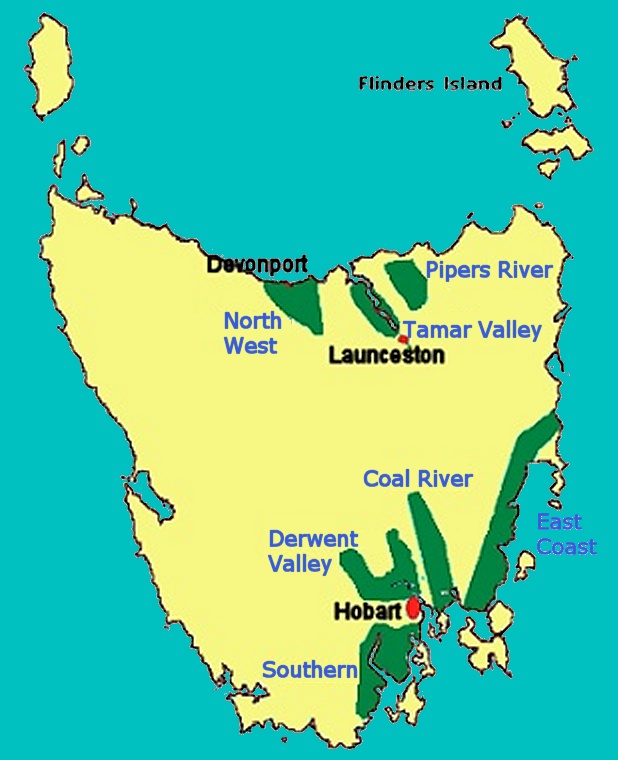
There are no formal wine regions in Tasmania,
the whole island is an official wine zone. However,
there is a broad division between Southern Tasmania and
Northern
Tasmania and within this division there are distinct
viticultural areas which include the Derwent Valley,
Coal River Valley, Huon Valley and D' Entrecasteaux
Channel in
the south; and Pipers Brook, Tamar Valley, the North
West and Eastern Tasmania in the north.
The island has a range of microclimates and soil types
which gives Tasmanian wines their diversity of
character.
Tasmania is the one of the oldest wine-producing region
in Australia, with successful vineyards near Hobart in
the early 1820s. Launceston was producing grapes in the
1830s and in East Tamar in the 1840s. Tasmanian wine was
shown at a Paris exhibition in 1848 and in 1866 eight
Tasmanian wines were entered in the Melbourne Inter-colonial
Exhibition.
The industry went into sharp decline by the end of the
19th Century and the island’s wine production all but
disappeared until the 1950s.